

2026 men’s knitwear is moving away from bulky seasonal staples. What’s showing up in brand orders and runway previews this year are lightweight constructions, open-stitch textures, and blends that bridge comfort with function. If you’re a brand or designer sourcing your next knitwear collection, here’s what’s actually trending and what it means for production.
1. Lightweight cardigans: the seasonal layering piece
Why lightweight cardigans work
Cardigans aren’t new, but the demand for lighter versions has picked up fast. Brands are looking for 7- to 12-gauge constructions that sit between a shirt jacket and a sweater. These work across three seasons—spring, early summer, and fall—which extends sell-through windows.
The 7-gauge open-front cardigan
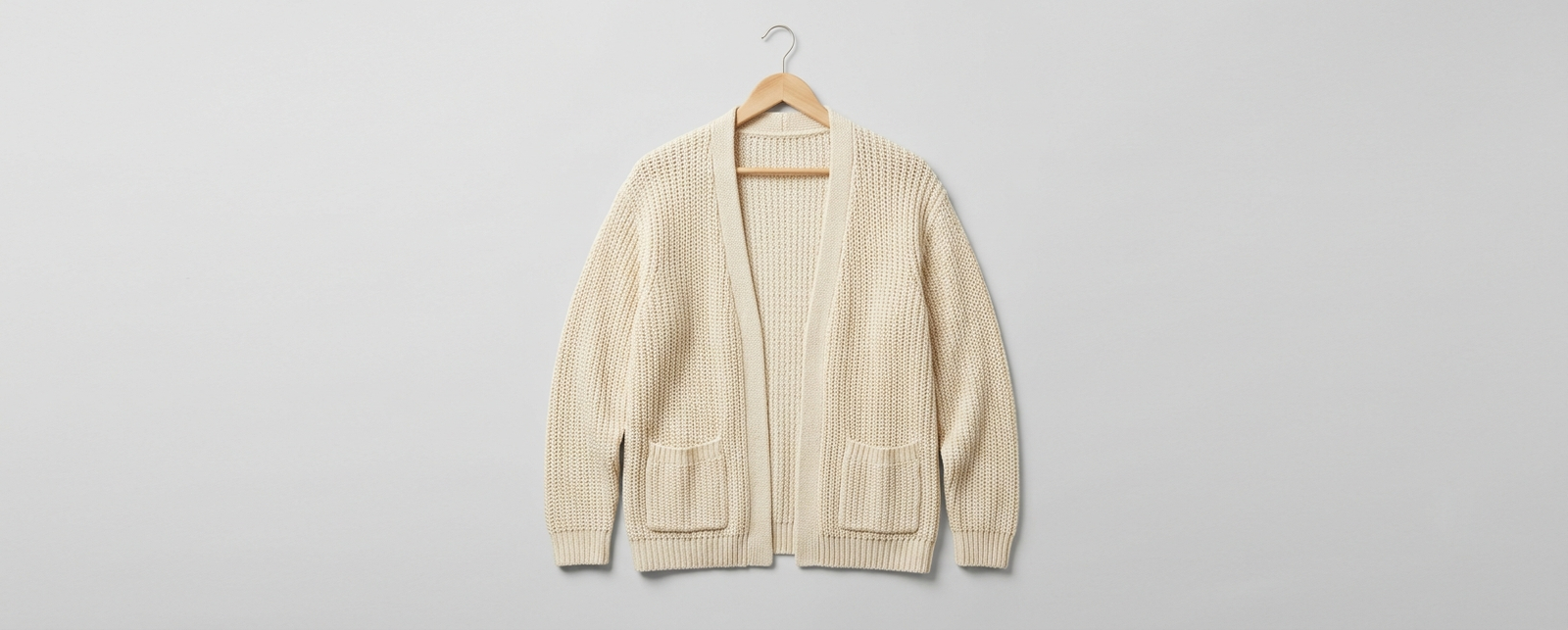
An open-front cardigan in 7-gauge, using a cotton-acrylic blend, gives you drape without bulk. The open weave keeps it breathable enough for air-conditioned spaces or cooler summer evenings. Front pockets and a clean hem finish keep the silhouette minimal.
The 12-gauge button-front cardigan
On the finer side, a 12-gauge button-front in a wool-nylon blend offers a tailored fit. It’s close enough to the body to layer under a jacket or over a tee. The finer gauge also means more stable fabric—less stretching, better shape retention over time. We’re seeing this requested most for capsule collection basics.
2. Texture knits: surface interest without print
What texture knits bring
Prints and jacquards have their place, but brands are shifting toward yarn-driven surface texture. Think slub yarn, bouclé loops, and contrast-rib panels. These structures add visual depth without printing or embroidery, which simplifies the QC process.
The bouclé crew neck
A 5-gauge bouclé crew neck sweater in a cotton-poly blend uses looped yarns to create a speckled, heathered effect. The bulkier gauge gives it a relaxed fit. It’s the kind of piece that looks high-end at retail but is straightforward to produce on standard flatbed machines.
The slub yarn polo
A 12-gauge knit polo in slub yarn (irregular thickness along the strand) adds subtle texture to a classic silhouette. The slub effect works best in natural tones—ivory, oatmeal, charcoal. A three-button placket and ribbed collar complete the look. A cleaner alternative to printed polos for SS26.
3. Technical blends: performance-friendly knitwear
What technical blends actually do
The term “performance knitwear” gets thrown around a lot, but it boils down to specific fiber choices. Nylon adds abrasion resistance. Elastane gives stretch recovery. Moisture-wicking treatments turn cotton blends into activewear-adjacent pieces. None of these are gimmicks—they solve real problems for the wearer.
The nylon-reinforced zip hoodie
An 8-gauge zip hoodie in a cotton-nylon blend. The nylon content (typically 15-25%) reinforces high-wear areas like elbows and cuffs, and nylon holds dye differently than cotton, which creates a faint melange look. A YKK zip front, side pockets, and a lined hood. This is your utility knitwear option.
The stretch-rib quarter zip
A 14-gauge quarter-zip mock neck in a cotton-elastane blend (95/5 or 92/8). The stretch rib construction gives it a slim fit that recovers its shape after each wear. The quarter zip makes it easy to layer. It’s a direct competitor to the merino base layer but at a lower price point.
4. What this means for brands and designers
- Gauge = use case. 5-gauge for statement texture, 7-8 gauge for transitional weight, 12-14 gauge for base layers and fine knits. Choose gauge, then build around it.
- Cotton-acrylic is the workhorse. It blends durability, colorfastness, and reasonable cost. For premium positioning, go wool-nylon or cotton-cashmere. For budget-friendly, T/R (polyester-rayon) blends hold shape well.
- Test slub and bouclé early. Texture yarns take longer to source and sample. Factor in an extra 2-3 weeks for yarn procurement before production starts.
- MOQ reality check. 100 pieces per style per color is our minimum. That’s enough for most independent brands to test a style without committing to container volumes. Need lower? We can discuss.
If you’re developing a knitwear collection for the coming seasons, start with the gauge and the blend. Everything else—fit, trim, finish—follows from those two decisions.
FAQ
What gauge is best for a lightweight men’s cardigan?
7-gauge to 12-gauge. 7-gauge gives an open, relaxed drape. 12-gauge is finer and more structured. Pick based on whether you want the cardigan to feel like a jacket (7g) or a base layer shirt (12g).
What’s the minimum order quantity for custom knitwear?
100 pieces per style per color. That covers sampling, pattern making, and bulk cutting. It’s enough for most independent brands to launch a new style without overcommitting.
Are texture yarns like bouclé and slub harder to produce?
They need extra sourcing time (2-3 weeks for raw material) and a sample approval cycle. But once the yarn spec is locked, production runs the same as standard yarns on flatbed machines.
Can you make performance knitwear without synthetics?
Technically yes—merino wool has natural moisture management. But adding nylon or elastane at 5-25% improves durability and stretch recovery significantly without changing the hand feel.