

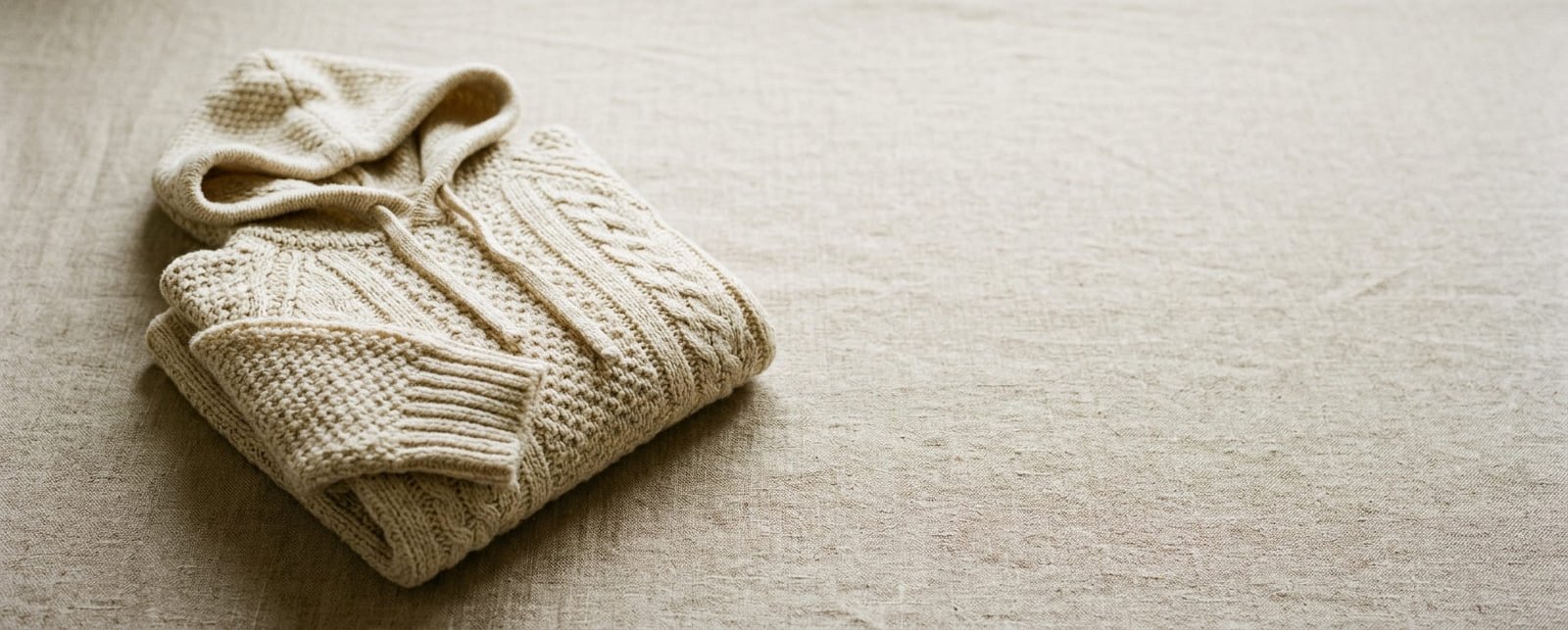
A knit hoodie is knitted to shape from yarn on flat knitting machines. The fabric and the garment are made in the same operation.
A standard hoodie is cut and sewn: the factory starts with a roll of already-knitted fabric, usually fleece or French terry, cuts panels out of it and joins them at a sewing line.
That one difference sets the handfeel, the drape, the weight, how the hood behaves, which design options are open to you and where the cost sits. A knit hoodie is a sweater with a hood; a cut-and-sew hoodie is a sweatshirt. A factory needs to know which you mean before it quotes or advises on yarn.
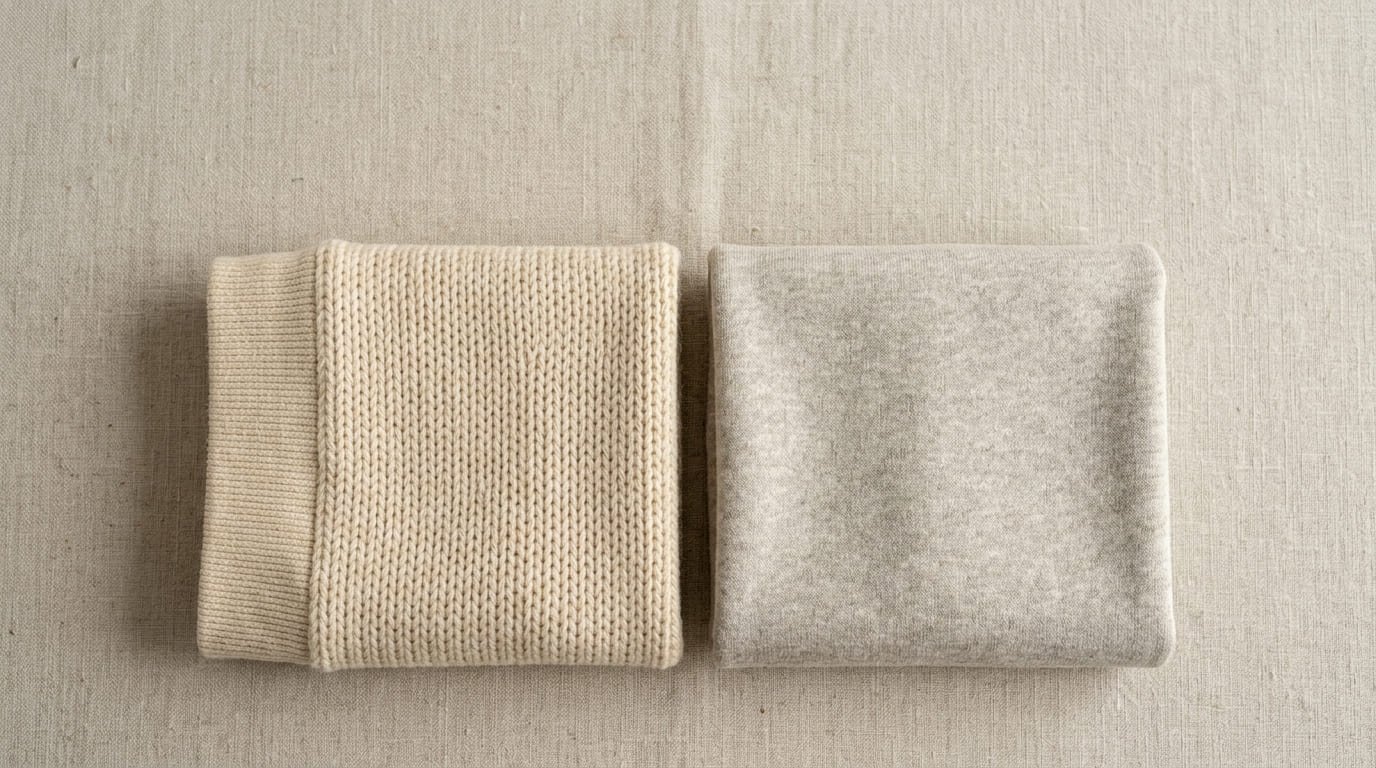
knit hoodie vs cut-and-sew hoodie
| What you are comparing | Knit hoodie | Cut-and-sew hoodie |
|---|---|---|
| — | — | — |
| How the garment is made | Panels are knitted stitch by stitch to shape, so the fabric and the panel are made in one pass. | The fabric is knitted first as a roll, then cut into panels and sewn. |
| Starting point | Yarn cones and a knit program. | A roll of fleece or French terry, plus a pattern and a cutting table. |
| Handfeel | Driven by yarn and stitch: soft, dry or springy, and it reads as knitwear. | Driven by the fabric: brushed or looped inside, consistent and familiar. |
| Drape and structure | Drapes like a sweater. Shape comes from stitch structure, gauge and ribs. | Holds its line through fabric weight and the cut. |
| Surface | Texture and knitted-in pattern: jersey, rib, Milano, links-links, cable, jacquard. | Print and hardware: screen print, puff print, embroidery, patches. |
| Typical fabric weight | Quoted in grams per piece, set by yarn count and gauge. | Quoted in gsm on the roll, the same number for every panel. |
| Hood construction | Knitted as its own panels, usually double-layered or self-lined, with the drawcord channel knitted in. | Cut from the same roll, often in two or three pieces, then sewn on. Eyelets and cord holes go in at sewing. |
| Seams and finishing | Edges arrive finished, so seams are linking or a light sewn join. | Every cut edge is overlocked, folded or cover-stitched, and the seams hold it together. |
| Where the design flexibility sits | In the knit program: stitch structure, gauge, knitted pattern, colour blocks, ribs. | In the cut and the decoration: silhouette, seam placement, print, embroidery, trims and hardware. |
| What the customer perceives | A sweater with a hood. Softer, smarter, usually read as premium. | A hoodie. Casual, athletic or streetwear, with a familiar weight and surface. |
Both routes can produce the same silhouette on paper. What changes is what the customer feels when they pick the garment up. The knitted version we build is on our knit hoodie product page.
how a knit hoodie is actually built
Flat knitting builds a panel stitch by stitch. The machine adds and removes stitches across the row to make the shape: a shoulder slope, an armhole, a wider body, a tapered sleeve. The panel comes off the machine in its final shape, which is what fully fashioned means, with the rib already knitted onto the edge. There’s nothing to trim and nothing to throw away.
Linking joins the stitches of one panel to the other for a flat seam, which is why knitwear sits smooth against skin.
Cut-and-sew runs the other way. Fabric arrives already knitted, dyed and finished, and panels are cut from the roll. The offcuts are waste, and every cut edge is raw until the sewing line overlock, folds or covers it.
Weight sits differently too. A fleece hoodie carries its weight in the fabric and the hardware; a knit hoodie carries it in the yarn and the stitch.
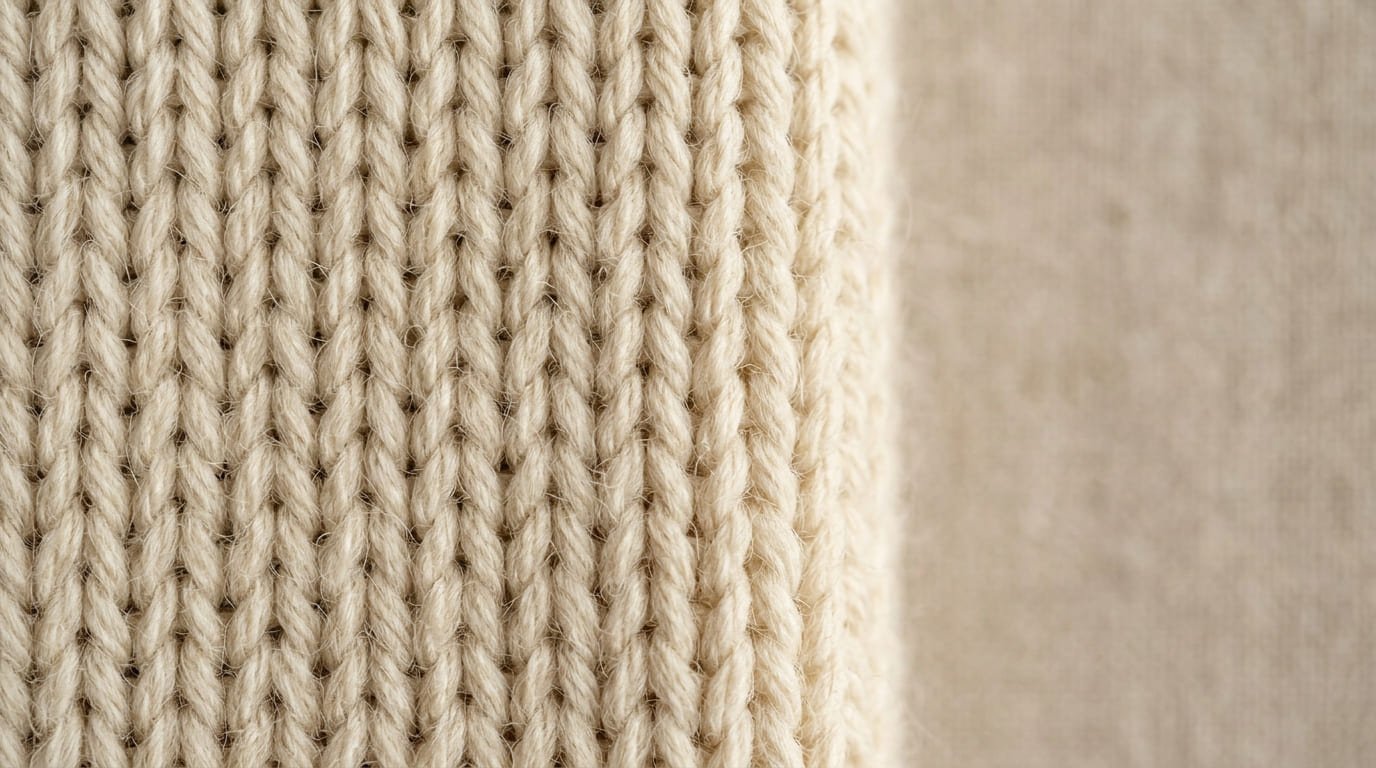
knitted hoodie constructions and what they look like
Each structure is knitted, not added on, and each changes the surface and the weight.
- Plain jersey — the base knit. One smooth face, one looped back, and the lightest option at a given gauge. It curls at the edges, so cuffs and hem need ribs.
- Rib — columns of knit and purl with stretch and tight recovery. As trim it holds a cuff and hem in shape; as a whole garment it gives a fitted, textured hoodie.
- Milano rib — denser and more stable, with a fine vertical line. It doesn’t curl, which suits structured hoodies and zip fronts.
- Links-links — knit and purl alternate for bumps and zigzags across the surface. Textured, stable, and common on chunky pieces.
- Double knit — two faces joined into one fabric, so both sides look finished. Often used where a hood has to hold shape on its own.
- Waffle — a grid of raised cells knitted in, which traps air and suits layering hoodies.
- Cable — twisted stitches forming raised rope lines. Cables add thickness and read strongly at coarse gauges.
- Jacquard — pattern knitted into the panel instead of printed on it, carrying colour across the row for repeats, stripes, logos and colour blocks.
Jacquard is the main reason a brand picks knit over fleece: the pattern is part of the fabric, so it can’t crack off the surface. Intarsia does the same for larger graphics, with no floats on the reverse. Fine printed detail is the other way round, which our hoodie fabric guide covers.
gauge and yarn for a knitted hoodie
GG is needles per inch on the machine bed. A low GG uses thicker needles and thicker yarn for a chunkier fabric; a high GG knits finer yarn into a closer surface. The scale is in what GG means in knitwear.
A knitted hoodie usually runs 5GG to 12GG, a product-typical range. Gauge decides whether the hood stands up or lies close to the head, and it sets how heavy the piece feels.
| Gauge | What it produces | Who it suits |
|---|---|---|
| — | — | — |
| 5GG–7GG | A chunky outdoor knit with real volume: thick yarn, large stitches, and a hood with body that stands up. | Cold-weather ranges, outdoor styles, and brands where texture is the product. |
| 9GG | Mid-weight knit with some body and a surface clean enough for mid-scale jacquard and texture. | Transitional collections and textured or patterned hoodies. |
| 12GG | A light, smooth, compact knit that layers easily, with a flatter hood. | Layering pieces, year-round ranges, and hooded knits worn like a shirt. |
The full product-to-gauge mapping sits on the knitwear gauge chart. Yarn follows the gauge: heavy two-ply counts give a chunky hood its structure, and fine merino or fine cotton gives a hoodie that packs down. Matching rules are in the yarn count and machine gauge guide.
what changes in production
The hood is the hardest part. Knit has no interlining to lean on, so a single-layer hood folds flat the moment it’s worn. The fix is a double layer or a self-lined hood in a firmer structure than the body. That’s more panels, more yarn and more finishing than a cut-and-sew hood.
The drawcord channel has to be knitted or finished into the panel. You can’t punch a hole through a knit hood edge the way you can through fleece, because a hole in knit fabric opens and distorts with wear. The channel is knitted as a tube along the edge or added as a facing, and the cord gets its own finish, from cord tips to a defined exit point.
Pockets and zips add steps. A kangaroo pocket is a separate knitted panel, and a welt pocket needs a knitted welt plus a bag. A zip front needs a facing or stabiliser strip, or the knit ripples along the zip, and zip weight has to suit knit weight.
Those are the places a knitted hoodie costs more than a fleece hoodie: yarn at coarse gauges, knit programming, extra panels, and more finishing labour. Lewen quotes per style after reviewing yarn, gauge, construction, trims and quantity.
when to choose knit and when to choose fleece
Choose a knitted hoodie when:
- texture is the reason the product exists
- the pattern should be knitted in rather than printed on
- a softer, smarter handfeel is what carries the price
- the silhouette should drape and layer under a coat
- the hoodie has to sit alongside a sweater range
Choose a cut-and-sew fleece hoodie when:
- volume streetwear weight is the product
- the artwork depends on screen print, puff print, embroidery or patches
- a heavy brushed interior is part of the promise
- the lowest possible unit cost at a given silhouette matters most
- the style has to match an existing basic hoodie spec
Neither is better. The question is whether your customer is buying a sweater with a hood, or buying a hoodie.
what to put in the brief
A knitted hoodie brief a factory can work from carries these fields:
- yarn composition and count
- gauge
- knit structure
- hood type and lining
- pocket type
- zip or pullover
- rib heights at cuff and hem
- drawcord finish
- colour and dye route
- size range
- target weight in grams per piece
There are two routes into the first conversation with a factory. Send a reference garment if you know what you want: the factory reads gauge, yarn class, structure and rib heights from the sample and matches them as closely as the available yarns allow. If you don’t have a reference, describe the product instead: target weight in grams, handfeel, season and silhouette, and let the factory recommend the gauge and yarn. First samples often move a little, so the description route usually saves a round of sampling.
Keep target weight and handfeel from pulling in opposite directions. A chunky 5GG hoodie and a light 12GG hoodie are two different products, not two versions of one.
common mistakes
- Briefing “hoodie” without saying whether it’s knitted or cut and sewn. The two carry different yarns, construction and costs, so a quote for the wrong one is meaningless.
- Assuming a knitted hoodie takes the same print artwork as fleece. Knit texture breaks up fine detail, and heavy ink sits on the surface rather than in it.
- Ignoring yarn consumption at heavier gauges. A 5GG hoodie uses far more yarn per piece than a 12GG version.
- Treating the hood as a cheap add-on. Shape, lining, drawcord channel and finishing all sit there, and a weak hood makes the piece look cheap.
- Choosing gauge by how it sounds rather than by target weight. Set grams per piece and handfeel first, then let the gauge and yarn follow.
where Lewen fits
Lewen Garment knits from 1.5GG to 18GG in Dongguan, Guangdong — wider than the 3GG to 18GG that’s standard across the Dalang cluster, with the extra range at the coarse end, where chunky hooded knits live. A 5GG outdoor hoodie and a 12GG layering hoodie run in the same building, so the tech team can tell you what your reference garment actually is.
Working reference points: MOQ 100 pieces per style per colour, sample development typically 7–10 working days, and bulk production typically 15–30 working days. Custom knit hoodie manufacturing covers development, and the wider capability set is on the custom knitwear manufacturer in China page.
FAQ
What is a knit hoodie?
A knit hoodie is knitted to shape from yarn on flat knitting machines, so the fabric and the garment are made in the same operation. A standard hoodie is cut and sewn from a fleece or French terry roll.
Is a knit hoodie the same as a sweatshirt hoodie?
No. A sweatshirt hoodie is cut and sewn from fleece or French terry. A knit hoodie is a sweater with a hood, softer in the hand and patterned in the knit rather than printed.
What gauge is a knit hoodie usually made in?
Most knitted hoodies sit between 5GG and 12GG. 5GG to 7GG gives a chunky hood that stands up, and 12GG gives a light hoodie that layers.
Can a knit hoodie carry a print or graphic?
It can, but knit fabric is textured, so fine detail loses definition. For graphic-led designs, jacquard or intarsia knits the pattern into the panel instead.
Is a knit hoodie more expensive to make than a fleece hoodie?
Usually yes. Heavier gauges use more yarn per piece, the hood needs a second layer to hold shape, and the drawcord channel, pockets and zip each add steps.
Can you make a knit hoodie with a zip?
Yes, but the knit needs a facing, placket or stabiliser so it doesn’t ripple along the zip, and the zip weight has to suit the knit weight.
For an upcoming style, send Lewen your reference garment or product requirements and we’ll review gauge, yarn and construction against your target weight and price.