

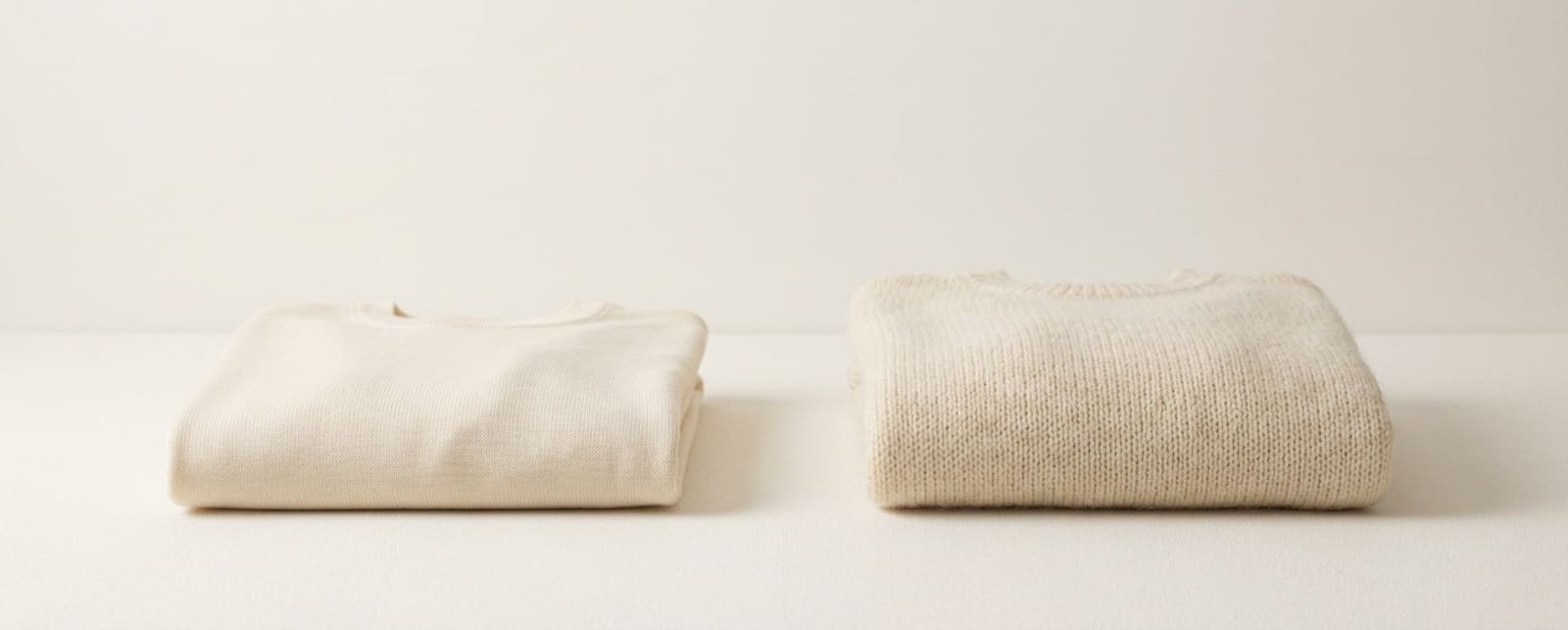
Both are sheep’s wool. What differs is the breed, the fibre diameter and how it behaves in a knit.
Merino comes from one breed group and is graded by micron — commonly around 17 to 24 micron depending on grade. Fine grades feel soft, sit against skin without prickle and knit cleanly at fine gauges. Lambswool is the first clip from a young sheep, usually under seven months. It’s softer than that animal’s later clips, but it isn’t finer than merino. It’s loftier, reads fuller and costs less per kilo.
Merino is the premium choice. Lambswool is the classic sweater wool at a friendlier price. Neither wins outright.
Two notes on wording before the detail. In the US you’ll see this garment called a sweater and in the UK and much of the Commonwealth a jumper — the fibre decision is the same either way. And lambswool also appears as two words, “lambs wool”, especially in product listings, so both spellings describe the same fibre.
what merino and lambswool actually are
merino is a breed, graded by micron
Merino is a sheep breed group, farmed in Australia, New Zealand, South Africa and South America. Fleece is graded after shearing: the micron number is average fibre diameter.
Clothing merino commonly runs around 17 to 24 micron depending on grade. Fine merino under roughly 19 micron bends against skin instead of pressing into it. Stronger merino above roughly 23 micron is durable and cheap, but not next-to-skin.
lambswool is an age, not a grade
Lambswool is the first shearing from a sheep under roughly seven months old. That fleece is finer and softer than what the animal grows later. That’s the claim in the name.
It isn’t a quality grade and it doesn’t set a micron. Lambswool commonly sits around 21 to 28 micron depending on breed and clip, and merino lamb clips come in finer. A coarse lambswool can feel scratchier than a medium merino, and a fine lambswool softer than a strong one.
So “lambswool” means young animal, first clip — not better wool, and not automatically softer.
merino wool vs lambswool: the comparison
| Merino wool | Lambswool | |
|---|---|---|
| — | — | — |
| Fibre source | Breed group; merino flocks in Australia, New Zealand, South Africa | First clip from a lamb under about 7 months; any breed |
| Typical micron range | Commonly 17–24 micron depending on grade | Commonly 21–28 micron depending on breed and clip |
| Softness and next-to-skin comfort | Fine grades feel smooth; the standard next-to-skin wool | Softer than that animal’s later clips, but not finer than merino |
| Itch potential | Low in fine grades, higher as micron climbs | Higher on average; fine clips and blends reduce it |
| Loft and handle | Dense, smooth and refined; worsted spin reads clean | Lofty, dry and full; more air in the yarn and a rounder hand |
| Stitch definition and texture | Fine, even stitches; holds fine jacquard and clean lines | Fills stitches and softens detail; gives cables and ribs body |
| Warmth-to-weight | High warmth per gram; fine gauge insulates without bulk | Reads heavier and warmer in the traditional sense; loft traps air |
| Shape retention and elasticity | Crimp recovers well at fine gauge; ribs hold tension | Good body in chunky knits; loose low-twist yarns can bag at cuffs |
| Pilling behaviour | Finer fibre and short staple can pill at friction points | Coarser fibre stays put and texture hides pills |
| How it takes dye | Even dye take; fine fibre gives clear, saturated shades | Takes dye well; loft and fibre mix give heathers and muted solids |
| Typical gauge | Commonly 12GG–18GG fine, 3GG–7GG chunky merino | Commonly 1.5GG–7GG chunky and cable, up to 12GG finer lambswool |
| Typical styles | Fine crewnecks, knit polos, base layers, cardigans, vests | Chunky cable crewnecks, traditional cardigans, fair isle, vests |
| Season | Autumn/winter, plus transitional and travel wear at fine gauge | Autumn/winter and deep winter |
| Care | Hand wash or wool cycle, dry flat; treated easy care yarns machine wash | Hand wash or wool cycle, dry flat; machine-wash treatments are less common |
| Cost position | Higher per kilo; the gap widens with finer micron and certified supply chains | Lower per kilo; the accessible route for volume winter programmes |
softness and micron: the number that decides itch
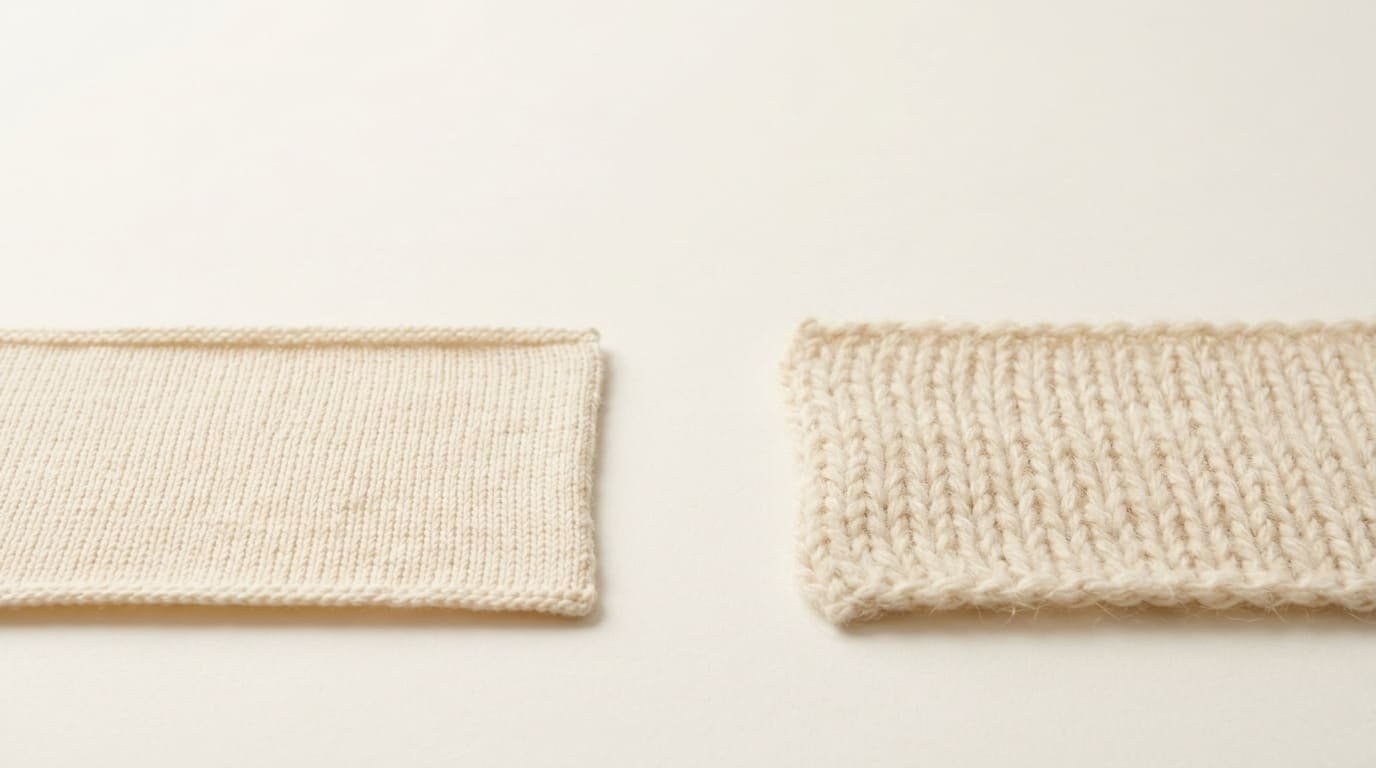
Prickle is mechanical. Coarse fibres stay stiff and press against nerve endings in the skin; thin fibres bend. Industry guidance commonly puts the comfort threshold around 21–22 micron for next-to-skin wear, and fine merino sits below it.
That’s why two sweaters labelled “wool” can feel nothing alike, and why grade beats the fibre name. A 24-micron merino crewneck is outerwear, not a base layer, and a 21-micron lambswool can feel smoother than its label suggests. Test the swatch on the inside of the wrist and the side of the neck, where itch complaints come from.
warmth-to-weight
Wool insulates by trapping still air, and fine merino packs more fibres into the same yarn diameter: more air pockets, more warmth per gram. A light merino crewneck layers under a jacket without bulk. Loftier lambswool reads heavier and warmer in the traditional sense.
Warmth is never a fibre property on its own. Gauge, stitch and grams per piece decide the number, and a tight 14GG lambswool can outperform a loose 7GG merino. The gauge explainer covers how needle count changes weight and surface. Brief a grams-per-piece target or a reference garment weight.
texture and stitch definition
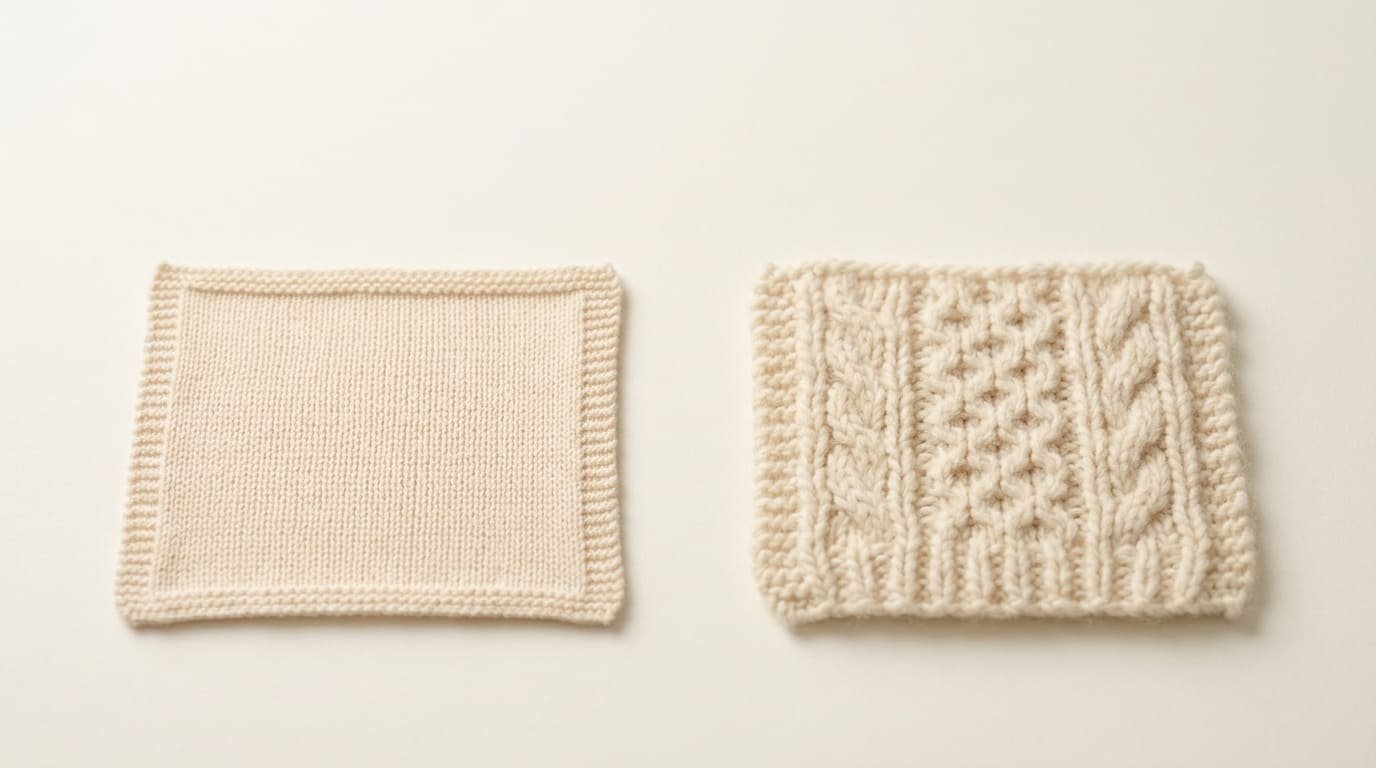
Lambswool’s loft fills the stitch. Cables, ribs, half-cardigan and fair isle read with more body, because the yarn bulges into the stitch and the halo softens the edges.
Merino reads smoother and more refined. Fine merino shows even stitches and holds fine jacquard without blurring, which suits clean lines and flat 12GG–18GG knits. If the style sells on texture, lambswool gives you more of it.
durability and pilling
Both wool fibres pill. A pill starts when a short fibre end works loose from the yarn and tangles with others. Finer fibres are less stiff, so lower-grade merino pills first at cuffs and underarms.
Long-staple merino spun worsted resists this, because fewer fibre ends reach the surface. Lambswool’s coarser fibre stays put, and chunky cables hide pills in the texture.
What the factory controls:
- yarn selection — staple length, micron and spin
- twist and ply, plus machine tension
- finishing — washing, milling and steaming
The cheapest fix for pilling is a better yarn, not a softer finishing claim.
care
Both fibres are wool, so care is the same: hand wash or wool cycle, cool water, wool-safe detergent, dry flat, no hot dryer. Heat and agitation lock the scales together and the garment felts. Our knitwear care guide by fabric type covers settings per fibre.
Merino is more often sold as a machine-washable yarn. Total easy care and superwash treatments let the fibre survive a wool cycle, at a higher yarn cost and a slight shift in handfeel. Lambswool can be treated too, but less often.
cost: what moves the number
Merino costs more per kilo than lambswool. The gap widens at every step down in micron, and again with certified supply chains.
There’s no single figure to quote. Yarn price depends on count, blend, treatment, colour, mill and order quantity. In broad industry terms, fine merino can run from a modest premium over lambswool to several times the price at the fine end. Those are industry positions, not Lewen prices.
Lambswool can still produce the more expensive garment, because a chunky cable uses far more yarn per piece than a fine merino crewneck. Yarn is only one line in the quote, and Lewen prices per project once the spec is locked.
when to choose merino
- premium positioning where the retail price supports the yarn
- next-to-skin comfort, and markets where “it itches” is a top return reason
- fine gauge work from 12GG to 18GG
- travel and layering styles where warmth-to-weight sells
when to choose lambswool
- classic winter sweaters and the traditional wool look
- chunky cables, ribs and textured stitches that need body
- texture-led design, where the surface is the product
- volume winter programmes where cost per piece matters
blends and the middle of the range
Blends solve one problem instead of picking a side.
- merino/nylon — durability and recovery. A low single-digit to roughly 20% nylon addition lifts abrasion resistance at cuffs and elbows.
- merino/cashmere — softness. Around 10–30% cashmere adds a luxury handle without much weight, and raises yarn cost. See our merino vs cashmere breakdown.
- lambswool/nylon — shape in chunky knits, so a cable keeps body through a winter season.
There’s a middle of the range too. A soft-handle lambswool from a better clip, or a coarser merino at the top of its range, lands between the extremes. That’s often right when the retail band won’t carry fine merino. Cotton vs wool knitwear covers the wider fibre-family fork.
a short decision framework
- Target retail price — does the band support the yarn after make and margin?
- Season and weight — deep winter, transitional, or both?
- Next-to-skin or outer layer — will this touch skin or sit over a shirt?
- Gauge — what needle count will you run?
- Surface — texture-led cable and rib, or smooth and graphic?
- Care story — can this customer hand wash, or do you promise machine wash?
- Reference garment — what weight, stitch and handle are you matching?
production notes at decision level
Micron and fibre length affect how the yarn spins and runs on the machine. Finer fibres need more twist and knit best at fine gauge. Coarse, lofty yarns run better at low gauge, where the stitch has room for the bulk. Read our yarn count and machine gauge matching guide before you lock the spec.
sampling advice
Start with a yarn swatch, not a sample garment. Ask the supplier for the micron and composition of the actual yarn used, not just the fibre name. “Merino” on a yarn card can mean 17 micron or 24 micron, and that gap decides handfeel and price.
Then describe the handle and care you want, and let the factory recommend the fibre, micron and gauge. Our knitwear manufacturer checklist sorts the spec.
where Lewen fits
Lewen Garment works with merino, lambswool and wool blend routes, and knits from 1.5GG to 18GG in Dongguan, Guangdong. The tech team advises on fibre, micron and gauge for your target handle and price, and flags when a choice pushes yarn weight or cost. More detail sits on our merino wool fabric page.
MOQs are flexible: around 100 pieces per style as a working reference. Send the brief to a custom knitwear manufacturer in China that runs both fibres.
FAQ
Which is warmer, merino wool or lambswool?
It depends more on the knit than the fibre. Merino insulates better per gram, so a fine merino layer can match a heavier lambswool one, while chunky lambswool feels warmer. Gauge, stitch and grams per piece decide the number.
Is merino wool or lambswool softer?
Fine merino is usually softer, because fibre diameter drives softness. Lambswool is softer than the same animal’s later clips, but not finer than merino by definition. A fine lambswool can still beat a coarse merino.
Is lambswool better than merino wool?
No. Lambswool describes the sheep’s age at first shearing, not a quality grade or micron. It gives a loftier, more traditional handle and costs less, which suits chunky winter sweaters.
Merino wool vs lambswool vs cashmere — what’s the difference?
Merino and lambswool are both sheep’s wool, separated by breed, micron and clip. Cashmere comes from goats, is finer again, and is lighter, softer and dearer. It’s usually blended in at 10–30% to soften a wool knit.
Is merino wool warmer than regular wool?
Merino is warmer for its weight, not in absolute terms. Its fine fibres trap more air per gram, so a thin merino knit insulates without bulk. A thick regular wool sweater can still be warmer overall.
Is merino or lambswool better for socks?
Merino, in most cases. Fine merino handles moisture and next-to-skin comfort better, which is what socks demand, and it’s why merino dominates the technical sock market. Lambswool is loftier and warmer but bulkier underfoot and less abrasion-tolerant in a thin knit. For a thick bed or boot sock, lambswool works; for everyday and athletic socks, merino is the safer spec.
Can you use merino and lambswool in the same sweater?
Yes, and it’s a common way to balance handle and price. A merino/lambswool blend, or either fibre blended with nylon or cashmere, lets you tune softness, loft, durability and yarn cost against the target retail price. Decide the composition before you lock the quote, because the blend changes the label claim.
If you’re choosing between merino and lambswool for a style this season, send Lewen your tech pack or reference garment and we’ll review fibre, micron and gauge against your target handle and price. Lewen runs custom sweater production in Dongguan from 1.5GG to 18GG, with low MOQs around 100 pieces per style.