

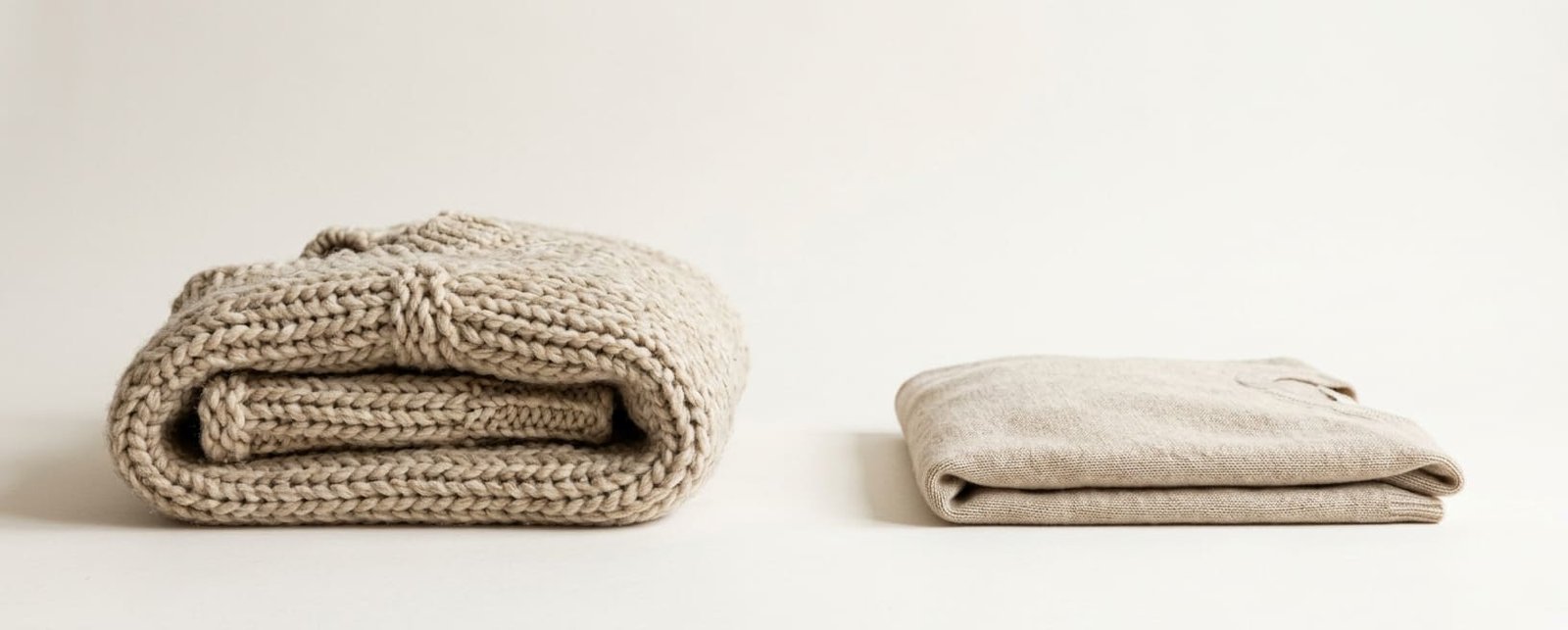
Heavy gauge knitwear runs from about 3GG to 7GG. It knits thick yarn on widely spaced needles and produces a substantial, textured, lofted garment that holds its own volume. Fine gauge knitwear runs from about 12GG to 18GG. It knits thin yarn on closely packed needles and produces a light, smooth, compact fabric that drapes close to the body, closer to a woven shirt than a sweater. 9GG sits between the two as the bridge. Neither end is better. They’re two different product families with different yarn, weight, cost and season logic, and the work is deciding which family your style belongs to before you brief a factory.
the two ends of the scale, in short
The practical range splits into three bands.
- Heavy gauge: 3GG to 7GG. Thick yarn, large stitches, fabric with real mass.
- Middle: 9GG. Enough body for a winter piece, enough density for a cleaner surface.
- Fine gauge: 12GG to 18GG. Thin yarn, dense stitches, light compact fabric.
What the numbers mean on the machine bed, and how the full scale runs from 3GG to 18GG, is covered in what GG means in knitwear. This article works one level up: how each family behaves, what it costs you, and which one your product needs.

fine gauge vs heavy gauge: the two families compared
| Heavy gauge (3GG–7GG) | Fine gauge (12GG–18GG) | |
|---|---|---|
| Typical gauge range | 3GG, 5GG, 7GG | 12GG, 14GG, 16GG, 18GG |
| Yarn weight it takes | Thick counts — bulky two-ply and heavier | Fine counts such as 2/48 Nm merino and fine cotton |
| Needles per inch | Few needles, widely spaced | Many needles, closely packed |
| Fabric character | Substantial, open, lofted | Light, dense, compact |
| Surface and texture | Big stitches, visible texture, hand-knit look | Smooth, flat, clean |
| Garment weight | Heavy | Light |
| Drape vs structure | Soft and drapey, or bulky and sculptural; collars and plackets need trims balanced against the body | Drapes close to the body, sits flat under a jacket |
| Silhouette it suits | Oversized, boxy, relaxed, statement shapes | Fitted, refined, close-to-body, layering shapes |
| Typical styles | Chunky pullovers, thick cardigans, exaggerated cable and rib, hand-knit look pieces | Lightweight sweaters, knit polos, layering knits, knit shirts, fine vests |
| Season | Autumn and winter, cold-climate programs | Year-round, strongest in transitional and warm-season drops |
| Knitting speed | Slow per stitch, but fewer stitches in the panel | Slower per square inch — more stitches per inch on a denser bed |
| Yarn consumption | High; the same shape uses far more yarn | Low; less yarn per garment |
| Cost position | Higher unit cost driven by yarn consumption, plus more shipping weight | Finer yarn often costs more per kilo and knits slower per square inch |
| Best for | Volume, texture, warmth, statement silhouettes | Refinement, layering, fine detail, longer selling seasons |
The two cost lines pull in opposite directions. Heavy gauge spends yarn. Fine gauge spends machine time.
what heavy gauge does best
Chunky pullovers, oversized and boxy statement knits, hand-knit look pieces, thick cardigans, exaggerated cable and rib styles, and winter programs all sit in this family. The fabric arrives with its own volume, so an oversized cut goes wide without going stiff, and texture carries a style that has no print, no trim and no hardware to lean on.
The trade-offs are real:
- Yarn consumption. A heavy gauge panel eats far more yarn than a fine gauge version of the same shape. That’s material you pay for by the kilo, and it’s the biggest single lever on the unit cost of a chunky style.
- Unit cost. More yarn, and usually a heavier trim package to match the body.
- Shipping weight. Heavy knits cost more to move, and the difference shows up on air freight and in any landed-cost calculation.
- Fine detail. Coarse stitches can’t hold it. Thin lines, small lettering and fine jacquard break down on a wide, open stitch, so artwork has to be redrawn bolder and simpler.
what fine gauge does best
Fine gauge covers lightweight sweaters, knit polos, layering knits, knit vests and knit shirts. It runs year-round programs and warm-season drops, and it handles fine jacquard, small motifs and fine typography cleanly, because a motif is built from more, smaller stitches. The surface is smooth and flat, which is what lets a knit sit under a jacket, stand in for a woven shirt on a retail floor, and hold a refined retail position.
The trade-offs:
- Opacity and finishing. Thinner fabric shows through. Light colours, fitted shapes and open stitches are the risk areas, and the neckline and hem need planning from the start, because less fabric mass sits behind the trims.
- Yarn price. Finer counts often cost more per kilo, especially fine merino and cashmere or silk blends.
- Knitting time. More stitches per inch means more machine time per square inch of fabric.
- Warmth per layer. A fine gauge knit gives less warmth than a heavy gauge one. For layering pieces that’s the point — it goes under something else.
where 9GG sits
9GG is the bridge between the two families. It has enough body for a winter piece and enough density for a cleaner surface than the chunky end, which is why it turns up in mid-weight sweaters, textured cardigans and styles that want presence without heavy winter weight. When the family is already settled and the question becomes the step either side of 9GG, that’s a gauge-by-gauge decision rather than a family one.

what gauge does to weight, handfeel and cost
Gauge changes three things you can judge before you ever see a price: how heavy the garment is, how it feels in the hand, and where the cost sits. The same design at two different gauges is two different products with two different cost structures.
| Gauge | Weight vs the same style at 12GG | Handfeel | Where the cost sits |
|---|---|---|---|
| 3GG | 2.5–3× | very chunky, open, hand-knit look | heaviest yarn bill and the most shipping weight |
| 5GG | around 2× | chunky with real mass | yarn line dominates |
| 7GG | 1.5–1.8× | dense, textured, classic winter | yarn line still dominant |
| 9GG | 1.2–1.4× | mid-weight with a defined surface | roughly balanced |
| 12GG | 1× (baseline) | smooth and compact | roughly balanced |
| 14GG | around 0.85× | fine and flat | machine time starts to lead |
| 16GG | around 0.75× | very fine, shirt-like | machine time dominant |
| 18GG | 0.65–0.7× | ultra-fine, close to woven | most machine time per square inch |
Coarse gauges eat yarn and fine gauges eat machine time, so cost doesn’t fall steadily in either direction — it dips where the two balance. Put numbers on it: a classic heavy crewneck at 7GG often lands in the 500–650g range, while the same silhouette at 12GG typically sits around 300–400g. At a wool price, that gap is worth more than the making cost of the garment. Where each line lands in a full quote is covered in what drives custom knitwear manufacturing cost, and if the gauge itself is still open, the knitwear gauge chart maps product types onto ranges.
Weight isn’t the whole handfeel story. A coarse knit reads as texture and loft — stitches you can see across the room. A fine knit reads as smoothness and drape — it sits close and stays flat. Two sweaters of identical weight can feel nothing alike, because stitch size changes the surface, not just the mass.
The ratios above are typical industry ranges for a men’s medium, not a quotation. Yarn count, stitch structure, fit and size range all move the real figure, and a firm number only comes back against a locked spec.
how to place your product on the scale
Seven questions settle most decisions.
- What season does it sell in? Cold-weather programs lean heavy. Year-round and warm-season lean fine.
- How much warmth does it need to give? A layer that insulates is heavy gauge. A layer that sits under something else is fine.
- What silhouette are you cutting? Oversized and boxy suits the heavy family. Fitted and refined suits the fine family.
- How smooth does the surface need to be? A visible, textured stitch points heavy. A flat, clean surface points fine.
- Does the design rely on fine detail? Small motifs, fine type and precise graphics need fine gauge. Bold texture needs heavy.
- What price point does the product support? Chunky styles carry material cost; fine styles carry yarn and machine time. Check that the retail price covers the family you picked.
- What does your reference garment show? Weight in the hand, stitch size, drape and surface tell a factory more than a written description does.
If two answers conflict — a boxy oversized shape that also needs a fine graphic, say — that’s the point to bring in a custom knitwear manufacturer instead of guessing. The shape can be reworked, the artwork can be redrawn, or the style can move to 9GG. What no single machine does is both ends of the scale at once.
which comparison to read next
Adjacent-gauge comparisons live in their own articles, because that’s where a decision gets specific. If your style sits at the chunky end, the 3GG vs 7GG comparison works through why two heavy sweaters still feel different. If you’re weighing the widest single jump in the range, the 7GG vs 12GG comparison covers the step from the heavy family into the fine one. And once you’ve settled on a fine knit, the 12GG vs 14GG comparison covers the two gauges behind most knit polos and shirt-like styles.
yarn at family level
Each family runs on its own yarn territory. Heavy gauge takes thick counts — bulky two-ply and heavier. Fine gauge takes fine counts, such as 2/48 Nm merino or a comparable fine cotton. Yarn thickness and needle density are one decision, not two, because a count that knits cleanly in one family won’t knit cleanly in the other. The pairing rules sit in our guide to matching yarn count and machine gauge.
sampling advice
If you have a reference garment, send it. A technician reads the fabric weight, stitch size and surface, and can usually place the style in the heavy, middle or fine family before anything is knitted. If you’re designing from scratch, describe the weight and handfeel you want — “thick and lofty with a visible stitch” or “light and smooth, close to a shirt” — along with the season, the fit and the target price, and let the factory recommend the family and the gauge.
Decide before sampling. A style can be translated between families, but the result is a different product: new yarn, new stitch density, different weight, different drape, usually different pattern dimensions. A chunky pullover rebuilt in fine gauge isn’t the same design knitted differently. It’s a new style, and the sample work starts again.
where Lewen fits
Lewen Garment knits from 1.5GG to 18GG in Dongguan, Guangdong — wider than the 3GG to 18GG that is standard across the Dalang cluster — so both families sit inside the machine range we run — heavy gauge at the chunky end, fine gauge at the fine end, and 9GG between them. Because both ends run in the same building, the tech team can tell you which family your reference garment belongs to, and what a style loses if it moves between them.
Lewen works from tech packs, sketches and reference garments. Typical sample development runs 7–10 working days, and bulk production typically runs 15–30 working days, depending on style, yarn and quantity.
FAQ
What is the difference between fine gauge and heavy gauge knitwear?
Heavy gauge runs about 3GG to 7GG and knits thick yarn on widely spaced needles, so the fabric is substantial, textured and lofted. Fine gauge runs about 12GG to 18GG and knits thin yarn on closely packed needles, so the fabric is light, smooth and compact, and drapes close to the body.
Is fine gauge or heavy gauge better?
Neither. Gauge is a machine measurement, not a quality grade. Heavy gauge gives volume, texture and warmth. Fine gauge gives refinement, layering and a longer selling season. The right family depends on the season, the silhouette and the price point.
What counts as heavy gauge knitwear?
Roughly 3GG to 7GG. These are the chunky gauges used for oversized statement knits, thick cardigans, exaggerated cable and rib styles, and winter programs. 9GG sits just above them as the middle weight.
Is heavy gauge knitwear warmer than fine gauge?
Per layer, yes. Heavier yarn and a lofted structure trap more air, so a heavy gauge sweater insulates more. Fine gauge pieces are made for layering instead, so more layers usually do the warming.
Can the same design be made in both fine gauge and heavy gauge?
It can be translated, but you don’t get the same garment. Yarn, stitch density, weight, drape and often the pattern dimensions all change. Decide the family before sampling, because a switch restarts the sample work.
Fine gauge vs heavy gauge is the first fork in a knitwear brief, and it’s usually decided before the yarn or the pattern. If you’re placing a style on the scale, send Lewen your reference garment or tech pack and we’ll review the gauge family, yarn and construction before you commit to sampling.
How much does gauge change the weight of a sweater?
A lot. Against the same style at 12GG, a 3GG version runs roughly two to three times the weight, a 7GG version about one and a half times, and an 18GG version around two-thirds. Yarn count, stitch and size move the figure, but the direction doesn’t change: coarser means heavier.