
![]()
Finding a good factory for your clothing brand is never easy, but sourcing knitwear comes with its own unique challenges. Unlike cut-and-sew garments, sweaters are made from scratch using yarn. The factory you choose needs to understand yarn types, knitting gauges, and finishing techniques — not just operate a sewing line.
If you are looking for a custom knitwear manufacturer in China, you need to look beyond the price. This guide covers what makes a qualified sweater factory, how to evaluate one before you commit, and the questions that separate serious manufacturers from the rest. Use it as your screening process, not a checklist you skim once.
Why knitwear manufacturing is different
A sweater starts as yarn, not fabric. That one difference changes how you should evaluate a factory. Cut-and-sew production buys fabric rolls and sews them into garments. Knitwear production turns yarn into knitted panels on machines, then links the panels together, then washes and finishes the garment. Every step depends on the one before it.
So a factory that looks good on paper can still fail you if its machines don’t match your product, or if its yarn suppliers can’t hit your color standards. Evaluate the whole chain: machines, yarn access, sampling, production control, and finishing. The sections below walk through each one.
Know the three factory models first
Before you evaluate any factory, decide which model you need. The three common setups are OEM, ODM, and private label.
- OEM (Original Equipment Manufacturing): You provide the design, tech pack, and materials spec. The factory produces to your spec. You keep full control, and you carry the responsibility for the design details.
- ODM (Original Design Manufacturing): The factory proposes designs or adapts existing styles for you. Useful when you want to move faster or when your team doesn’t design knitwear in-house.
- Private label: You buy a factory’s existing styles, often with your own label and packaging. Lowest effort, lowest differentiation.
Most brands sourcing custom knitwear use OEM with some ODM support for development. The choice affects which questions you ask and what you should expect from the factory. See our breakdown of OEM vs ODM in knitwear manufacturing if you are deciding between the two.
1. Technical expertise and machine capability

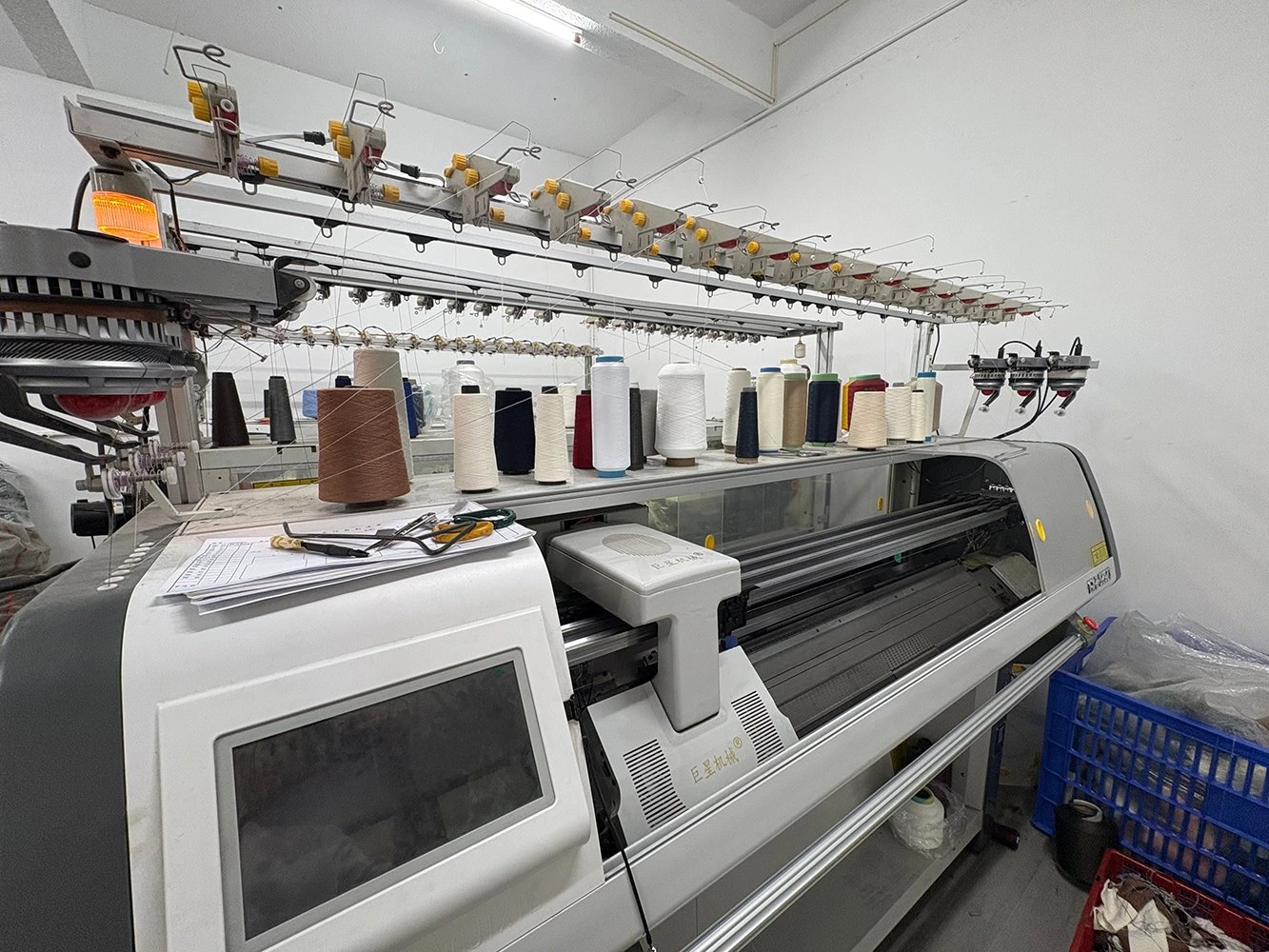
Not all knitwear factories are the same. A factory that makes heavy winter wool sweaters might not be the right choice for fine, lightweight cashmere cardigans. Ask about their machine gauges first.
The gauge (gg) is the number of needles per inch on the knitting machine. Lower gauges like 3gg or 5gg are for chunky sweaters. Higher gauges like 12gg or 14gg are for fine, thin knitwear. A reliable manufacturer will tell you exactly which gauges they run and which product types they specialize in. If they hesitate or give you a vague answer, treat it as a warning sign.
You also want to know whether they use computerized flat knitting machines. Computerized machines handle complex patterns, intarsia, and fully-fashioned shaping with consistent quality. Factories that rely mainly on manual machines are limited in what they can produce well. And check whether the factory’s specialty matches your product — a factory focused on custom sweater manufacturing may not be the right fit for knit polos or cardigans. For a deeper look at how gauge works with yarn, read our yarn count and machine gauge matching guide.
2. Strong yarn sourcing network

A great sweater starts with great yarn. A qualified custom knitwear manufacturer does not just knit — they help you source the right materials. They should have working relationships with local yarn spinning mills, not just a phone list.
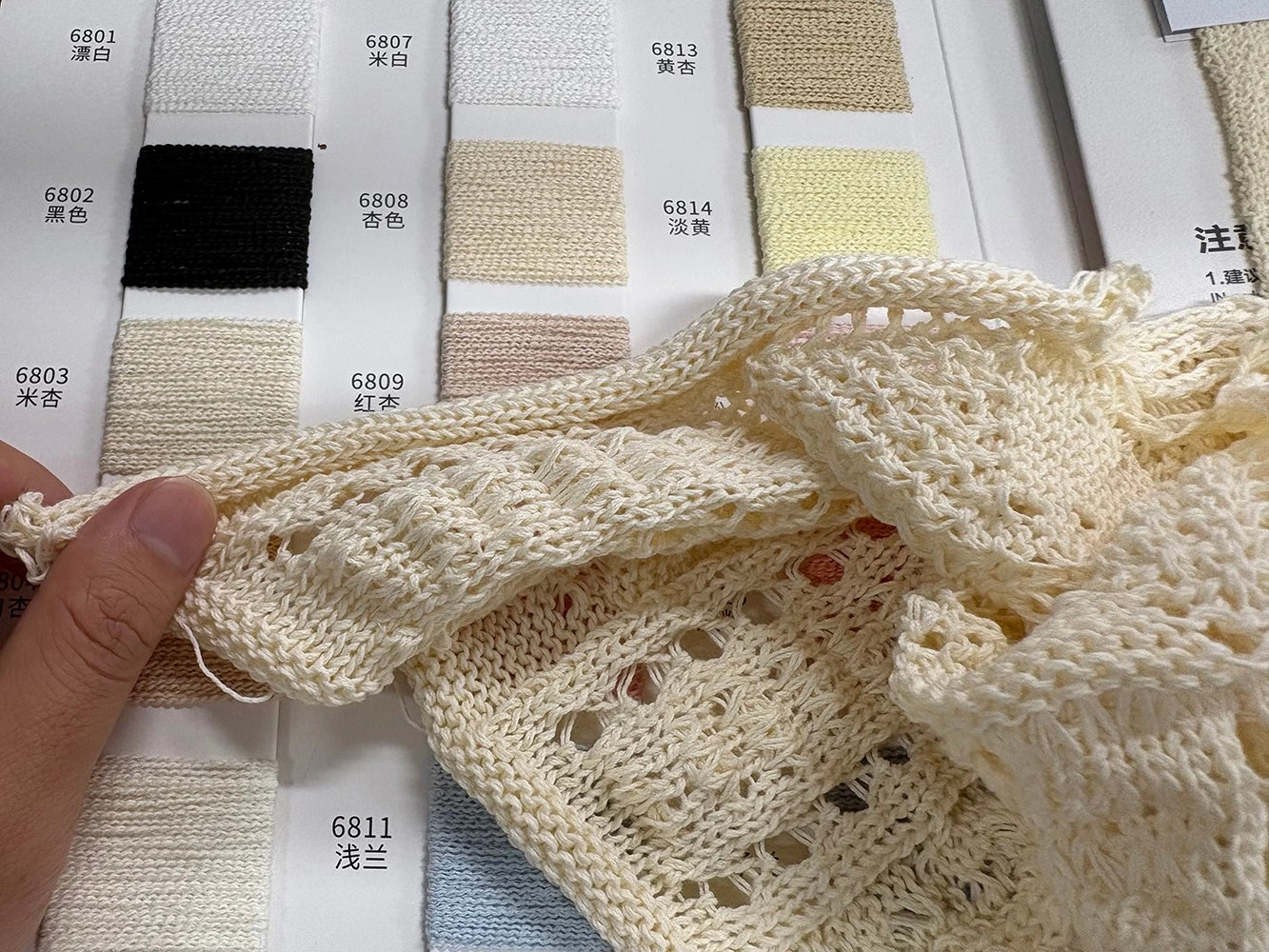
Whether you need basic cotton-acrylic blends, extra-fine Merino wool, or sustainable options like organic cotton and recycled polyester, the factory should be able to pull yarn color cards quickly. If a factory struggles to find the materials you want, it shows a lack of industry resources. Ask to see their yarn library or color card collection during your first call.
3. A realistic MOQ for your business
MOQ is a dealbreaker for many brands. In the Chinese knitwear industry, MOQ usually depends on the yarn, not the factory’s preference.
- Stock yarn: colors already available from the spinning mill. A good factory can often accept a lower MOQ — for example 100 to 300 pieces per style. At Lewen Garment we run low-MOQ knitwear production from Dalang and accept 100 pieces per style with stock yarn.
- Custom-dyed yarn: dyeing to your Pantone colors raises the MOQ because dyeing vats have minimum batch sizes. Plan for several hundred pieces per color.
- Mills-run (custom-spun) yarn: the highest MOQ tier, usually in the thousands, because the spinning mill needs a full production batch.
Choose a factory whose MOQ aligns with your business size. A factory that forces a massive MOQ on a startup is not a good long-term partner, while a small workshop might struggle to scale when your brand grows. Get the MOQ in writing, per style and per color, before you invest in sampling.
4. Sampling capability
The sample is the closest look you get at a factory’s real ability. Ask these questions before you pay for one:
- How long does a development sample take? Two to three weeks is typical for knitwear. Longer might mean a weak production schedule.
- How many revision rounds are included? One or two rounds of adjustments are normal. Unlimited re-sampling is not realistic and hides cost elsewhere.
- Do they check the sample against your tech pack, or just knit what they think you mean? The second one costs you time.
A factory that points out potential problems in your tech pack before sampling — yarn weight, gauge choice, stitch structure — is showing you how they will behave in bulk production. That is the behaviour you want. For the full production flow from yarn to finished garment, see our custom sweater manufacturing guide.
5. A strict quality control process
Knitwear production involves many steps: knitting, linking (joining the panels), washing, ironing, and packing. Problems can appear at any stage. Improper washing, for example, can shrink a sweater or ruin its hand-feel.
Ask the manufacturer how their QC actually runs. A reliable factory will have:
- Inline inspection: checking panels before linking, when defects are cheapest to fix.
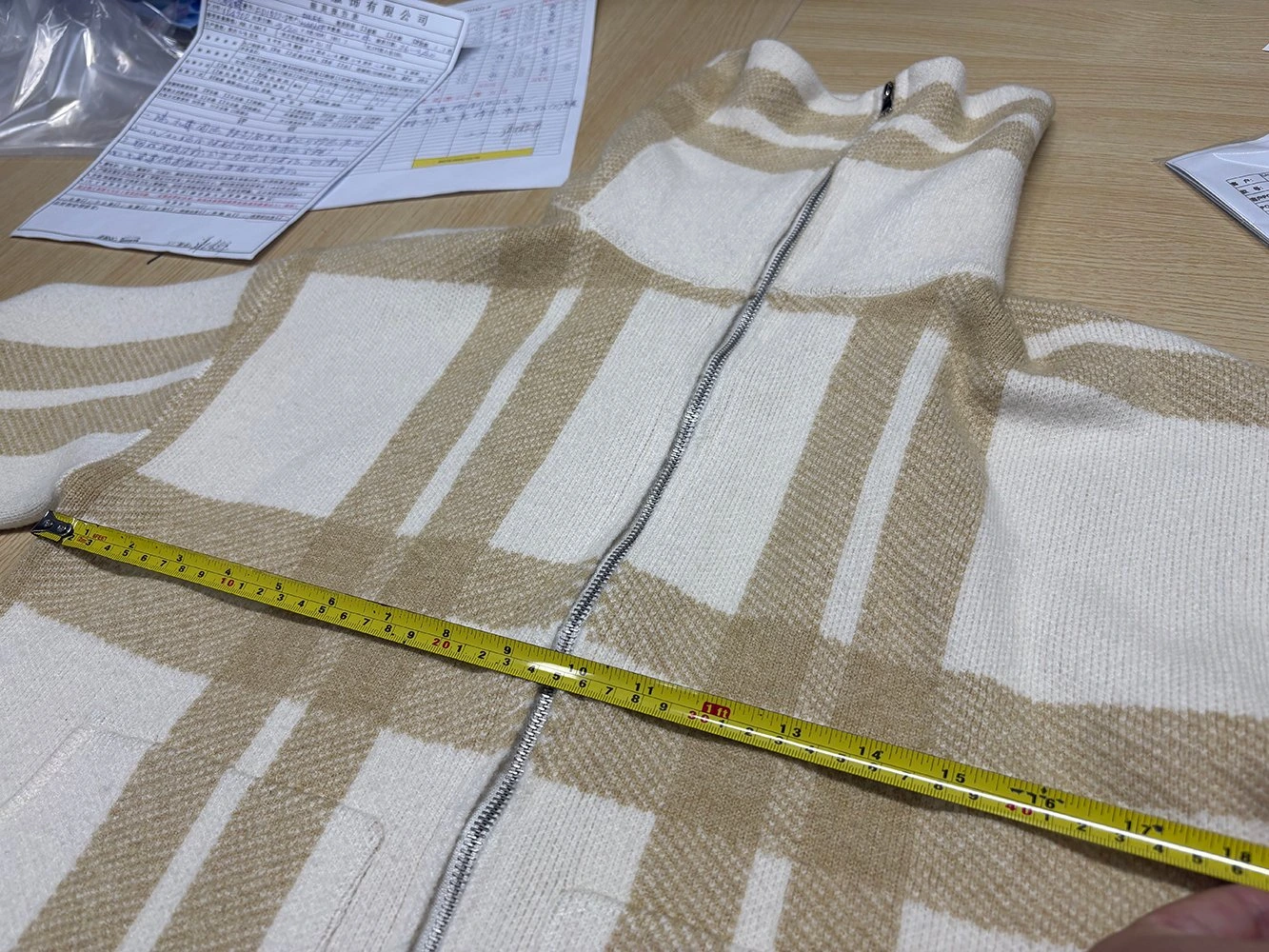
- Measurement checks: verifying the finished garment matches your tech pack after washing and ironing — knitwear stretches and shrinks, so measurements are taken at the right moment in the process.
- Final inspection: checking for loose threads, holes, stains, and color issues before packing.

If you plan to ship large orders, ask whether they offer third-party inspection (SGS, Bureau Veritas, or similar) and whether they use AQL sampling standards. A factory that welcomes independent inspection is usually confident in its own process.
6. Realistic production lead time
Lead time is where sourcing plans die. Ask for the factory’s current production schedule, not their brochure timeline. Typical knitwear bulk production runs four to eight weeks depending on yarn availability and order size, but the number that matters is their real queue today.
Be extra careful around the pre-autumn peak (July to September), when factories in knitwear hubs like Dalang are fully booked. A factory that promises the same speed in peak season as in March is either overstating or pushing your order to a subcontractor. Get the delivery date in writing, with a penalty clause if late delivery hurts your launch.
7. Clear communication and responsiveness
When you manufacture overseas, communication is your most important tool. You do not need a factory that speaks perfect English, but you do need a merchandiser who understands technical clothing terms and can translate between your design intent and the production floor.
Pay attention to how they reply to your first emails. Do they answer your questions directly? Do they point out potential problems in your tech pack before making the sample? A factory that says “yes” to everything without asking technical questions is a red flag. A reliable partner gives professional suggestions to improve the design or save cost.
8. A transparent price structure
Ask for a full breakdown, not just a unit price. A serious quotation includes yarn cost, knitting, linking, washing, finishing, packing, and the FOB terms. Then ask what is not included: sampling fees, lab dips, carton markings, and inspection fees are common add-ons that surprise first-time buyers.
Compare quotes on the same spec, not on the same garment type. Two factories quoting “a wool sweater” can differ by hundreds of dollars because the yarn count, weight, and finish are different. Also ask how prices change with volume and with yarn price movements — wool and cashmere prices move, and a good factory will explain the mechanism instead of silently raising the price later. Tariff changes have been shifting sourcing decisions; our 2026 knitwear sourcing and tariff guide covers the current landscape.
9. Social compliance and certifications
As consumers care more about ethical fashion, your supply chain needs to be transparent. Ask if the factory has third-party audits or certifications such as BSCI, WRAP, or Sedex. Not every small factory will have these — they are expensive to maintain — but a factory that follows local labor laws, pays fair wages, and keeps a clean, safe working environment is essential for a stable relationship.
If you sell into the EU or North America, ask which certifications your market actually requires. Some retailers demand specific audits, and it is cheaper to confirm this before you commit than to switch factories later.
10. Verify before you commit
Everything above can be answered well on a call. Verify it before you send a deposit:
- Video tour: ask for a live video walkthrough of the factory floor. If they refuse, ask why.
- Reference clients: ask for two or three current buyers you can contact. A real factory has them.
- Order a sample first: the cheapest way to test everything — communication, quality, and honesty — is a paid development sample.
- Check the location: factories in established knitwear hubs like Dalang in Guangdong have access to yarn mills, dye houses, and skilled knitters within a short radius. That ecosystem is hard to replicate elsewhere. We explain why in our Dalang knitwear story.
Red flags to walk away from
- Can’t name their machine gauges or yarn suppliers.
- Says yes to every request with no technical pushback.
- Quotes a price before seeing your tech pack or yarn spec.
- Refuses a video tour or third-party inspection.
- Promises peak-season delivery at off-season speed.
- Asks for a large deposit before any sample exists.
Summary: your decision checklist
Choosing a custom knitwear manufacturer takes time, but the process is straightforward if you work through it in order. If you want to see how one factory organizes all of this — machines, yarn sourcing, sampling, and QC — our factory page walks through the full setup.
- Pick your model: OEM, ODM, or private label.
- Confirm their gauge range matches your products.
- Check yarn access and color card turnaround.
- Get MOQ in writing, per style and per color.
- Test them with a paid development sample.
- Confirm QC process, lead time, and price breakdown.
- Verify with a video tour and references.
You are not looking for the cheapest factory. You are looking for the one that understands yarn, gauge, and finishing — and that treats your tech pack like a contract, not a suggestion.
Looking for a custom knitwear manufacturer? Lewen Garment is a knitwear factory in Dalang, Guangdong, producing men’s and women’s knitwear since 2002 with a 100-piece MOQ. Contact our team to discuss your next collection.
Frequently asked questions
What is the MOQ for custom knitwear?
With stock yarn, many factories including Lewen Garment accept around 100 to 300 pieces per style. Custom-dyed yarn raises the MOQ to several hundred pieces per color, and mills-run yarn can require thousands. Confirm MOQ per style and per color in writing before sampling.
How long does custom knitwear production take?
Development sampling typically takes two to three weeks, and bulk production four to eight weeks depending on yarn availability, order size, and the season. Avoid relying on fast promises during the July-to-September peak.
What is the difference between a knitwear manufacturer and a supplier?
A manufacturer owns the machines and runs production. A supplier or trading company arranges production with third-party factories. With a manufacturer you deal directly with the people who knit your product; with a supplier you add a middle layer that can dilute communication and QC control.
How do I check if a knitwear factory is reliable?
Ask for their machine gauge range, yarn suppliers, MOQ terms, sampling process, QC procedure, and a price breakdown. Then verify with a video tour, buyer references, and a paid development sample before committing to bulk production.
What does GG mean in knitwear?
GG stands for gauge, the number of needles per inch on a knitting machine. Low gauges (3GG to 5GG) produce chunky knits; high gauges (12GG to 14GG and above) produce fine, lightweight fabric. Matching the gauge to your yarn is one of the first technical decisions in any knitwear project.