

If you’re a brand looking at a knitwear line for spring/summer 2026, the short version is this: lightweight is no longer just a seasonal option. It’s the core request we’re getting from buyers across Europe, Australia, and the US. The search data backs it up — “lightweight knitwear men” is one of the fastest-growing queries right now, alongside “mens knitwear trends 2026” and “summer knitwear 2026.”
What that means on the factory floor is a shift away from heavy 3-5gg winter knits toward finer gauges, open stitches, and blended yarns that actually breathe. Here’s what we’re seeing.
1. lightweight knitwear moves from exception to standard
Why summer knits work
The idea of wearing knitwear in 30°C heat sounds wrong until you’ve handled a 16gg cotton-silk blend. At that gauge, the fabric has enough airflow to function more like a woven shirt than a sweater. It’s not about warmth anymore — it’s about drape, texture, and structure without bulk.
For brands, that means your knitwear line no longer has to sit idle from May to September. With the right spec, a lightweight knit polo or cardigan sells year-round.
The shift in buyer behavior
We’ve noticed more brand briefs coming in specifying “4-season” or “transitional” weight. That’s not just a marketing angle. When a 14gg garment can work under a jacket in winter and on its own in summer, inventory risk drops. Retailers like that math.
2. fine-gauge polos: 16-18gg, cotton-silk or pima cotton
What fine-gauge actually brings
At 16gg and above, each row of knitting has more stitches per inch. The result is a smoother, denser surface with a fabric “hand” that feels closer to a fine woven than a traditional sweater. It drapes better, wrinkles less, and holds shape after repeated wear.
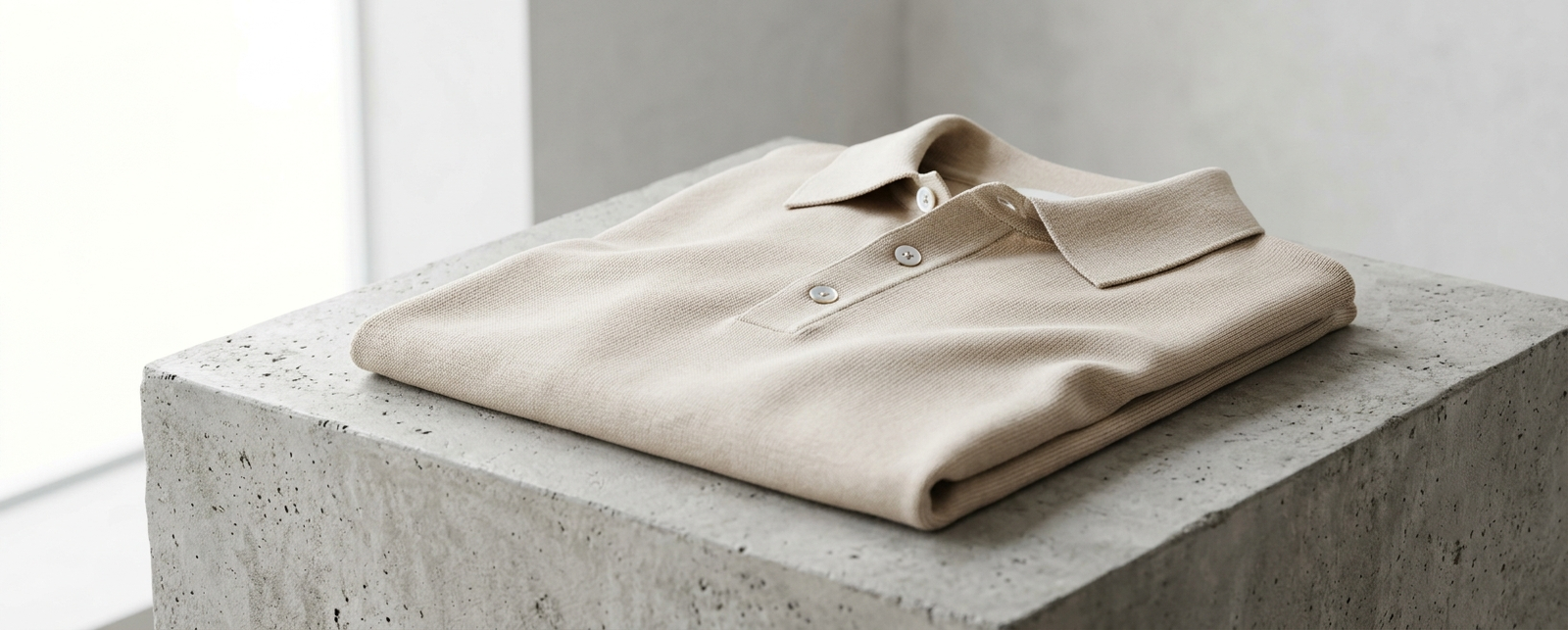
For polos, we’re producing mostly in 16gg and 18gg. The structure is clean enough for button-down collars without looking stiff.
The collar construction detail
A common request we’re seeing: a knit polo with a collar that stays crisp without interfacing. The trick is using a separate knit structure for the collar — usually a 1×1 rib at a tighter tension — then hand-framing it onto the body. It’s not faster, but it looks better and survives the wash.
3. textured cardigans: 12gg, cotton-linen blends, open-stitch patterns
What 12-gauge brings
12gg is the sweet spot for layering pieces. Open enough to breathe, dense enough to hold a textured pattern. You get good stitch definition without the drape getting too floppy — which can happen at 14gg+ with certain yarns.
Open-stitch constructions
Textured knits (honeycomb, waffle, basketweave) are trending for SS26. These aren’t just surface decoration. Open stitches create natural ventilation channels. A honeycomb pattern on a 12gg cotton-linen cardigan can drop the effective warmth by about 30% compared to a jersey knit of the same gauge.
That’s the kind of spec that makes a cardigan wearable on a 25°C evening.
4. what this means for brands sourcing summer knitwear
- Gauge choice drives everything. Don’t pick a gauge based on what you’ve done before. For SS26, 12gg-18gg covers most lightweight applications. If you want something that feels like a shirt, go 16gg+. If you want texture and drape, 12gg is your zone.
- Fiber blend matters more than the knit structure. Pure cotton at 12gg can still be heavy. A cotton-silk or cotton-linen blend sheds weight and adds breathability. Plan for longer lead times if you’re going with a custom blend — yarn sourcing adds 2-3 weeks.
- Sample in the target climate. A knit that feels light in a 22°C air-conditioned showroom might not perform the same way at 33°C in Sydney. We recommend sending a wear-test sample before committing to bulk.
- MOQ reality for lightweight knits. Fine-gauge production runs the same MOQ as standard gauge — 100 pcs per style at Lewen Garment. The difference is yarn cost: silk blends and long-staple pima cotton are more expensive, so factor that into your landed cost.
Fine-gauge knits and smart fiber blends are turning the “summer sweater” from a contradiction into a product category. SS26 is the season to act on it.
FAQ: lightweight knitwear for brands
Can knitwear really work for summer?
Yes, when you use the right gauge and fiber. 16gg+ cotton-silk or cotton-linen blends breathe well and feel light against the skin. The key is stitch density — finer gauges with open structures allow airflow while maintaining a polished look.
What’s the difference between 12gg and 16gg for lightweight knits?
12gg is more textured and structured — good for cardigans and open-stitch patterns. 16gg is smoother and drapes better — closer to a woven shirt feel. Your choice depends on whether you want visible texture (12gg) or a fine, polished surface (16-18gg).
What’s the MOQ for custom lightweight knitwear?
At Lewen Garment, MOQ starts at 100 pcs per style across 3 sizes. For single-size runs, it can drop to 50 pcs. Yarn blends (cotton-silk, cotton-linen) may need a minimum yarn purchase that affects the effective MOQ — best to discuss during sampling.
How long does sampling take for fine-gauge knits?
Simple fine-gauge styles take 7-10 days for the first sample. If you need custom yarn (e.g., a specific cotton-silk blend ratio), add 2-3 weeks for yarn sourcing and spinning. Bulk production runs 15-30 days after sample approval.