

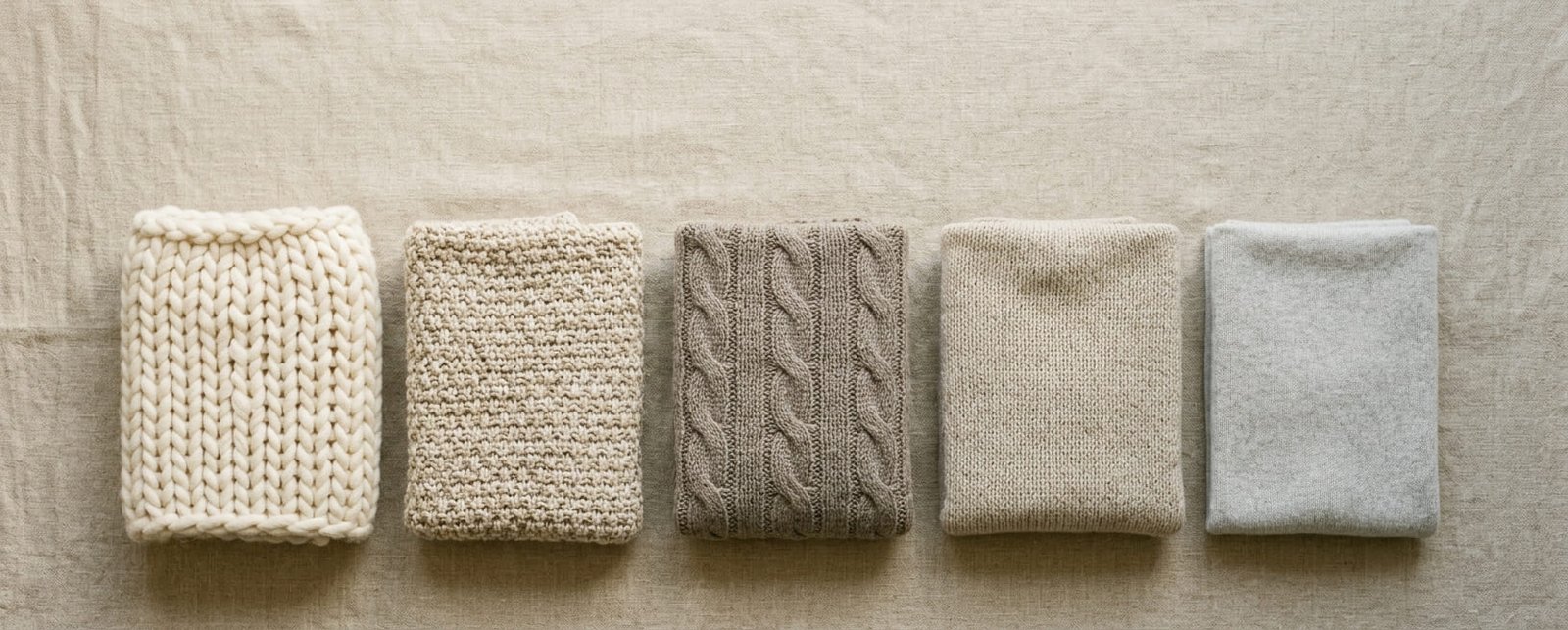
There’s no single gauge for a sweater, a cardigan or a polo. Gauge follows the target weight, handfeel and season of the piece you’re designing, and the product type only narrows the range you’re choosing inside. The working rule: a heavier piece with visible stitch texture pulls the gauge down, a lighter and smoother piece pulls it up. The chart below maps the common product types onto the gauge ranges that usually suit them — chunky pullovers at 3GG to 5GG, classic heavy crewnecks at 7GG, mid-weight sweaters at 9GG, standard and layering knits at 12GG, fine polos and summer knits at 14GG to 16GG, very fine knit shirts at 18GG. Use it to place your style before the first factory call, then let the factory confirm it with the yarn in hand.
what GG counts, in short
GG is needles per inch on a flat knitting machine bed. Fewer, thicker needles — a low GG — knit thick yarn into a chunky, open fabric. More, finer needles — a high GG — knit thin yarn into a dense, fine fabric.
That’s enough to read the chart. The scale itself, how gauge differs from stitches per inch in the finished fabric, and the exceptions are covered in what GG means in knitwear and in the fine gauge and heavy gauge breakdown. This article stays on the mapping question: which number belongs to which product.
the knitwear gauge chart
| Product type | Typical gauge range | What that gauge does for the product | Yarn weight that usually rides with it |
|---|---|---|---|
| — | — | — | — |
| Chunky and oversized pullovers, thick cardigans | 3GG–5GG | Large stitches and real mass. The fabric holds an oversized or boxy silhouette instead of collapsing, and the texture carries a style with no print, trim or hardware to lean on | Bulky two-ply counts and heavier |
| Classic heavy crewnecks, aran-style cables, heavyweight cardigans | 7GG | Winter weight with defined stitch texture. Cables read clearly, and collars, plackets and deep ribs hold their line | Two-ply wool or wool-blend counts around 2/28 Nm and heavier |
| Mid-weight sweaters, textured and jacquard styles | 9GG | The bridge gauge. Some body without full winter bulk, and a surface clean enough for mid-scale jacquard and structured textures | Mid counts, between the heavy 2/28 Nm band and the fine 2/48 Nm band |
| Standard sweaters, layering knits, year-round pullovers, knit polo basics | 12GG | Light, smooth, compact fabric that layers easily and sells across seasons. Clean trims, neat ribs, small-scale patterns | Fine counts such as 2/48 Nm merino, fine cottons and fine blends |
| Fine knit polos, knit shirts, lightweight cardigans, fine summer knits | 14GG–16GG | Dense, flat, shirt-like surface that drapes close to the body. This is the finest gauge most knit polo programs run | Fine counts, often 2/48 Nm to 2/60 Nm; single-ply for lighter summer versions |
| Very fine knit shirts and knit tees | 18GG | The finest surface on the scale. Thin, smooth and almost woven in appearance, with the least visible stitch | High-twist fine counts, 2/60 Nm and finer |
| Knit vests | 5GG–14GG | Varies more than any other product. An outerwear vest sits coarse so it has volume on its own; a layering vest sits fine so it disappears under a jacket | Follows the position: thick counts at 5GG, fine merino or fine cotton counts at 12GG–14GG |
| Knit dresses | 12GG–14GG | Drape matters more than warmth. A dense fine knit hangs straight and stays close to the body without adding bulk through the hip | Fine counts with enough twist to recover, often wool blends or viscose blends |
| Knit pants and knit bottoms | 7GG–12GG | Structure and recovery matter here. Too fine and the fabric has no body, so seams, waistbands and hems lose their line | Mid to heavy counts; 7GG–9GG for structured styles, 12GG with a compact yarn for lighter versions |
| Knit hoodies | 5GG–12GG | 5GG–7GG for a chunky outdoor knit with volume in the hood and around the drawcord; 12GG for a light layering hoodie that packs down | Thick counts at the coarse end, fine counts at the layering end |
Read the table by weight, not by price. A 5GG hoodie and a 12GG hoodie are different products for different buyers, not cheap and good versions of the same thing.
the logic behind the chart: three questions
The ranges come from three questions. Answer them for your style and you can place a product that isn’t in the table.
How heavy should the finished piece feel? Weight follows yarn thickness, and yarn thickness follows the gauge that can take it. A winter pullover with real mass needs a coarse bed and a thick yarn. A layering knit doesn’t. Going heavier pushes the gauge down. Going lighter pushes it up.
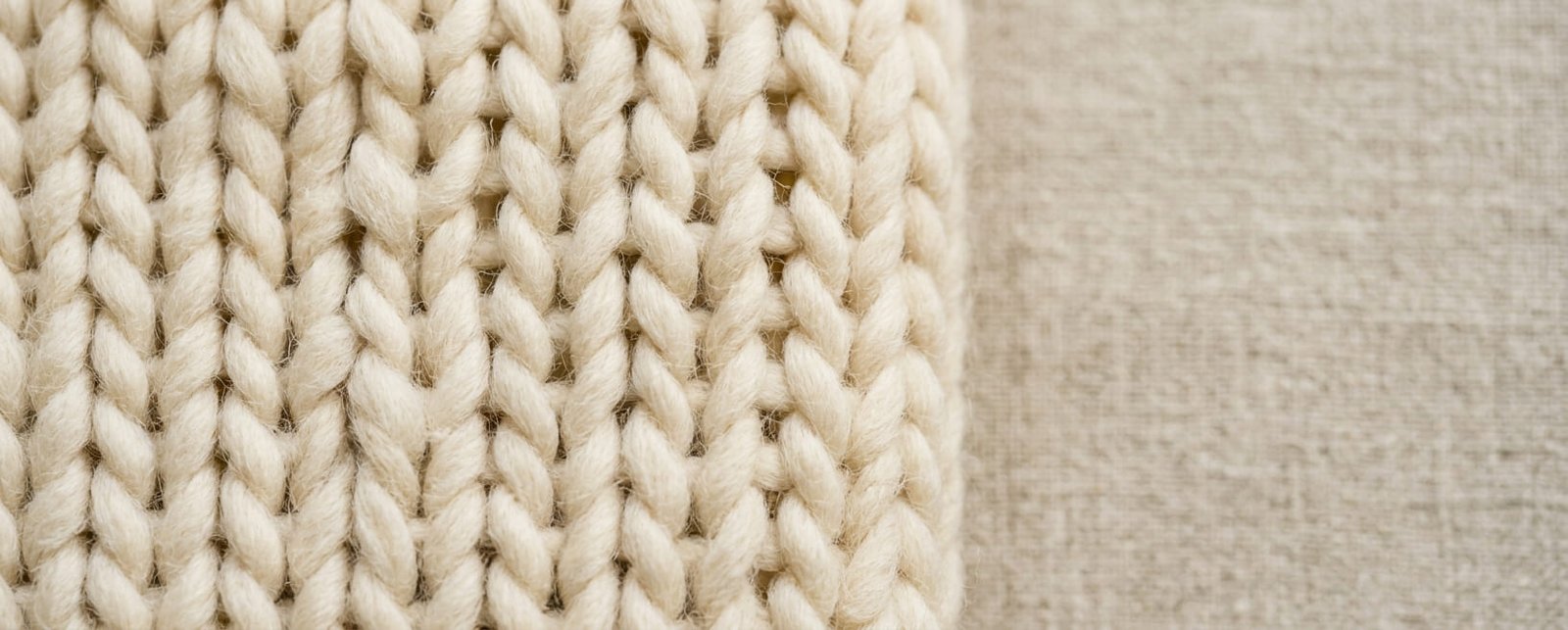
How defined should the stitch texture be? Cables, ribs, links-links and pointelle all need room to form. At 3GG to 7GG the stitches are large and the texture reads from across a room. The same cable at 14GG reads as a faint line. Want the texture to speak, go coarser. Want a smooth surface, go finer.
How much drape versus structure does the silhouette need? Coarse fabric has body and stands away from the body, which is what an oversized or sculptural shape needs. Fine fabric collapses and follows the body, which is what a long dress or a fitted polo needs. More structure pushes the gauge down. More drape pushes it up.
A worked example. Say you’re developing an oversized fine-gauge cardigan for a warm market. The oversized silhouette pulls the gauge down, because the shape needs some body. The light weight and smooth surface pull it up. 9GG is where those two answers meet, and 12GG is a legitimate second option if the cardigan is meant to feel closer to a shirt. That’s the kind of split a factory resolves with yarn samples in hand, not on paper.
what this chart is not
It’s a starting point for a conversation, not a specification you can lock on your own.
Gauge without a yarn count isn’t a spec. Every gauge takes a band of yarn counts, and the same gauge needs different counts for different product types. The matching rules are in the yarn count and machine gauge guide, so this article doesn’t repeat them.
The same product type can legitimately run two gauges apart in different markets. A heavy crewneck built for a cold-climate winter program and a mid-weight crewneck built for a milder market are both correct products on the same page of your line sheet.
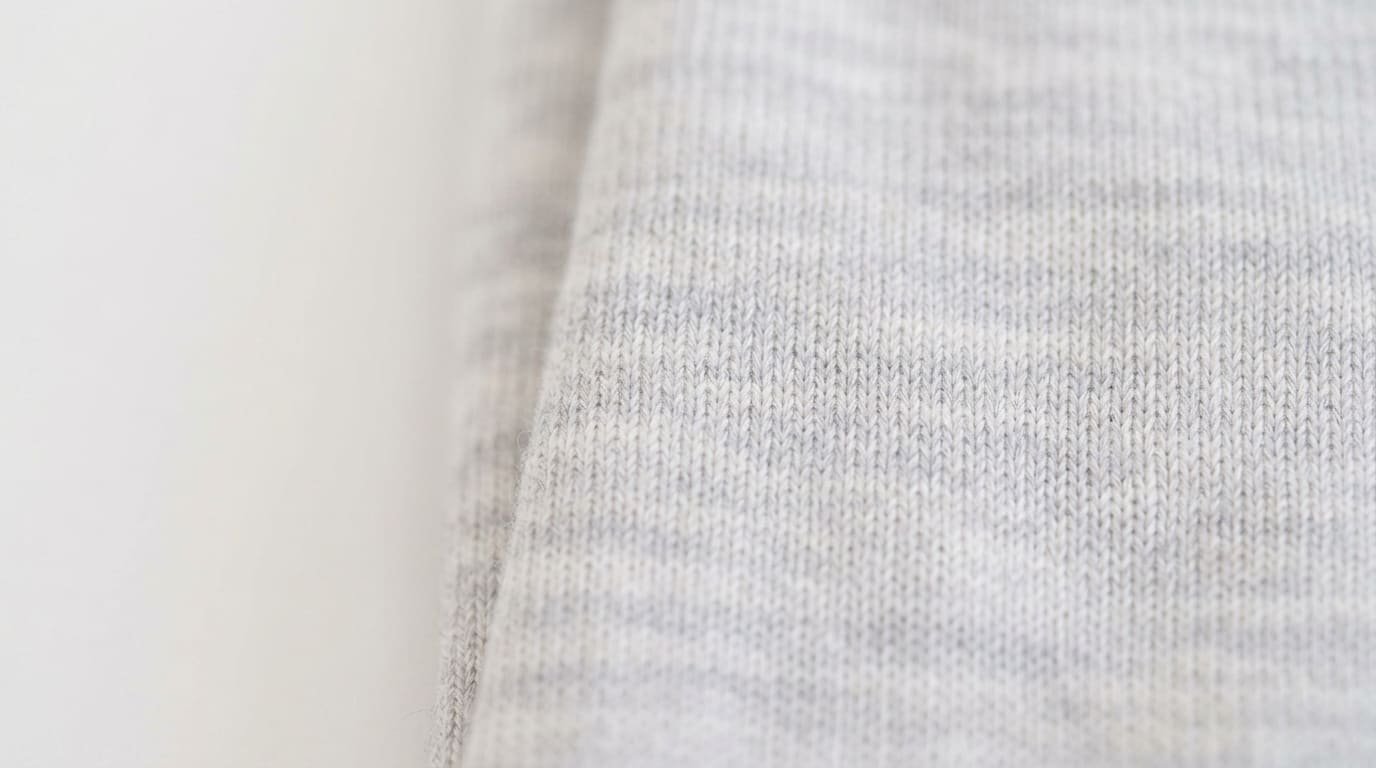
Two factories can quote the same gauge and still produce different fabric. Gauge sets the needle spacing. Stitch length — the programmed loop size — and the finishing route decide how that fabric actually feels, how much it recovers and how it washes.
yarn weight and machine time: where the middle band sits
Coarse gauges eat yarn. The same silhouette at 5GG uses far more grams of yarn than at 12GG, and yarn is the biggest single cost line in most knitwear programs, so the yarn bill climbs quickly at the coarse end.
Fine gauges eat machine time. More needles per inch means more stitches per square inch, and more stitches means more minutes on the machine to knit the same panel. Fine yarn also often costs more per kilo at the top of the range.
That’s why “finer is cheaper” and “coarser is cheaper” are both wrong. The economical band for a product is where yarn consumption and machine time balance, and for most knitwear that band sits in the middle of the chart rather than at either end. Think in grams and knitting minutes for your style, not in a gauge that sounds efficient.
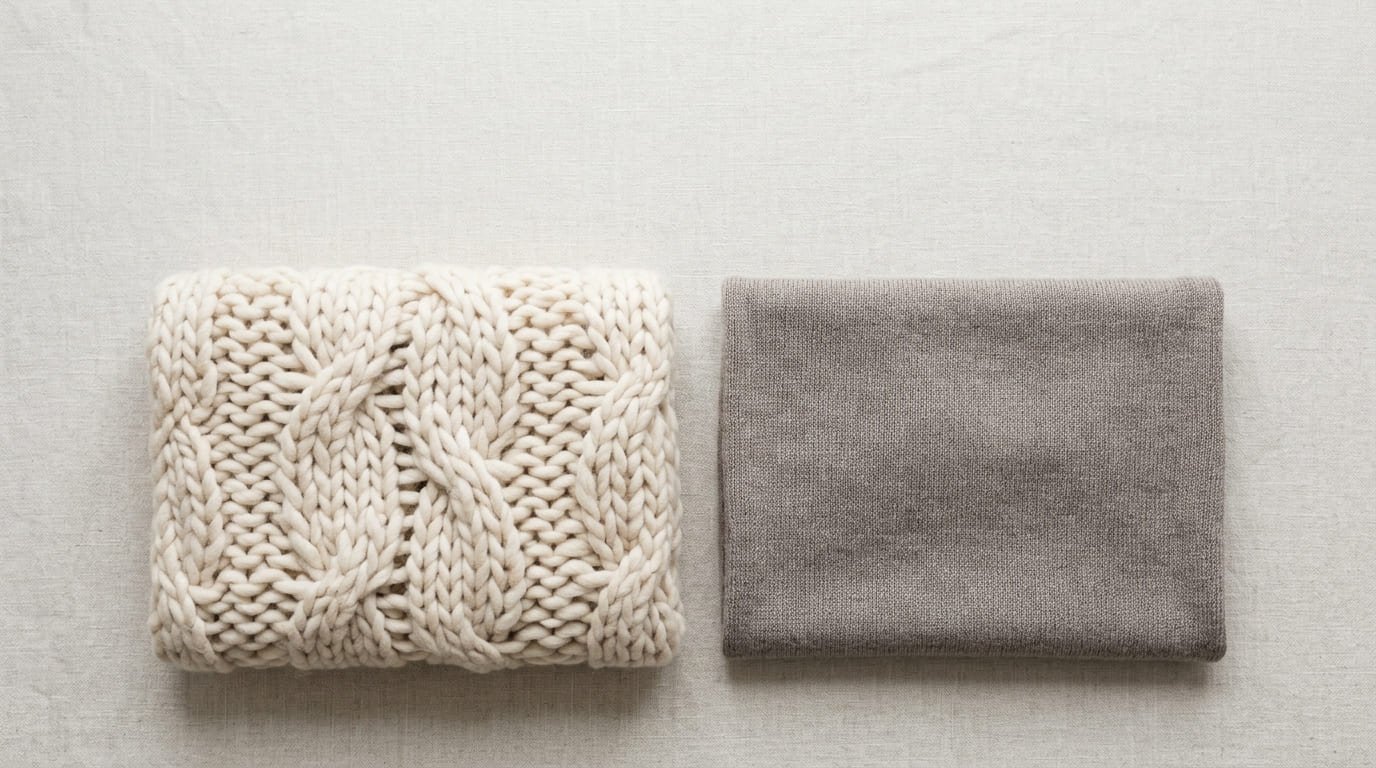
how to use the chart in a briefing
Two routes into the first factory conversation.
You have a reference garment. Bring it, or send it. The factory measures the fabric, the stitch structure and the garment weight, and can name the gauge and usually the yarn count before anything is knitted. That turns a vague brief into a concrete one.
You’re designing from scratch. Describe season, silhouette, target weight and handfeel in plain words — a heavy winter sweater that keeps its shape, or a light knit that drapes like a shirt. Give the chart range you think you’re in, then let a knitwear manufacturer recommend a gauge rather than picking one yourself.
The question to ask is: what gauge do you recommend for this style, and why? A factory that answers with a reason — the yarn it would use, the structure it would knit, the machine it would run — is telling you how it actually works. A factory that just repeats your number back has told you nothing.
common mistakes
- Choosing a gauge because it sounds premium. 14GG isn’t a better number than 7GG. It’s a machine size, and it makes a different product.
- Assuming one gauge covers a whole collection. Most knitwear ranges legitimately run three or four gauges across a season, because the pieces have different weights and jobs.
- Ignoring that the same gauge needs different yarn counts for different products. A 12GG knit polo and a 12GG knit dress rarely take the same count, even though both sit at the same needle density.
- Locking the gauge before the yarn is chosen. Gauge and yarn count are one decision. Fix one without the other and the sample comes back wrong, or comes back right by luck.
- Treating the chart as a spec sheet. It’s a range, not a locked number. It gets you into the right conversation, and the number gets settled during development.
When your choice sits between two neighbouring gauges, read the close comparison before you brief: 7GG vs 12GG works through the most common call in the middle of the chart line by line.
where Lewen fits
Lewen Garment runs 1.5GG to 18GG in Dongguan, Guangdong, which is wider than the 3GG to 18GG that is standard across the Dalang cluster — the extra range is at the coarse end. That matters for the heavy rows of this chart, because a machine range that stops at 3GG has no room left below it when a yarn runs thicker than expected or a style needs an even larger stitch.
Lewen works from tech packs, sketches or reference garments, and reviews yarn and construction with the brief. Typical sample development runs 7–10 working days, and bulk production typically runs 15–30 working days depending on style, yarn and quantity. The gauge recommendation comes back with the review.
Send Lewen your design, tech pack or reference garment and the team will recommend a gauge and yarn for the style. Men’s and women’s programs are both handled in-house, so a mixed collection doesn’t split across suppliers: custom men’s knitwear, custom women’s knitwear. If you’d rather start with the conversation than a file, send your product requirements to Lewen and describe the weight, handfeel and season you’re targeting.
The chart tells you which band your product sits in. Which yarn count and stitch length to run inside that band is a knitwear manufacturing decision, and it’s worth settling before you pay for samples.
FAQ
Is there a standard gauge for a sweater?
No. Sweaters run across the whole scale. Chunky and oversized pullovers sit at 3GG to 5GG, classic heavy crewnecks and cables at 7GG, mid-weight styles at 9GG, and standard year-round sweaters at 12GG. The product type narrows the range; the target weight, handfeel and season pick the number inside it.
What gauge is a chunky sweater?
3GG to 5GG for an oversized or statement chunky pullover, where the large stitches and yarn mass are the point of the design. If you want chunkier than a standard sweater without going that far, 7GG is the usual middle ground — heavy and textured, but easier to sell across a winter range.
What gauge is a knit polo?
12GG is the standard for knit polo basics: light, smooth and clean enough for a placket, collar and neat ribs. Fine knit polos and knit shirts move up to 14GG to 16GG for a denser, flatter, more shirt-like surface, and 18GG for the finest versions.
Can one gauge cover a whole collection?
It can, but you’d be giving up weight range in the line. A collection with a chunky outerwear piece, a layering knit and a fine polo needs at least two or three gauges, because those pieces have different jobs. Collections that run on one gauge are usually narrow by design.
How do I find out what gauge my reference garment is?
Send it to the factory. Technicians measure the fabric, the stitch structure and the garment weight, and can identify the gauge and usually the yarn count. If you’re designing from scratch instead, describe the season, silhouette, target weight and handfeel, and let the factory recommend a gauge with a reason attached.