

“Cable knit sweater” and “cable knit pattern” are evergreen searches — they’ve been in the top knitwear search terms for over a decade, and 2026 is no different. The cable is one of the oldest knitting techniques in the book, and it’s still one of the strongest sellers. Here’s why it endures, and what a brand needs to know before sourcing one.
1. The cable is texture you can feel
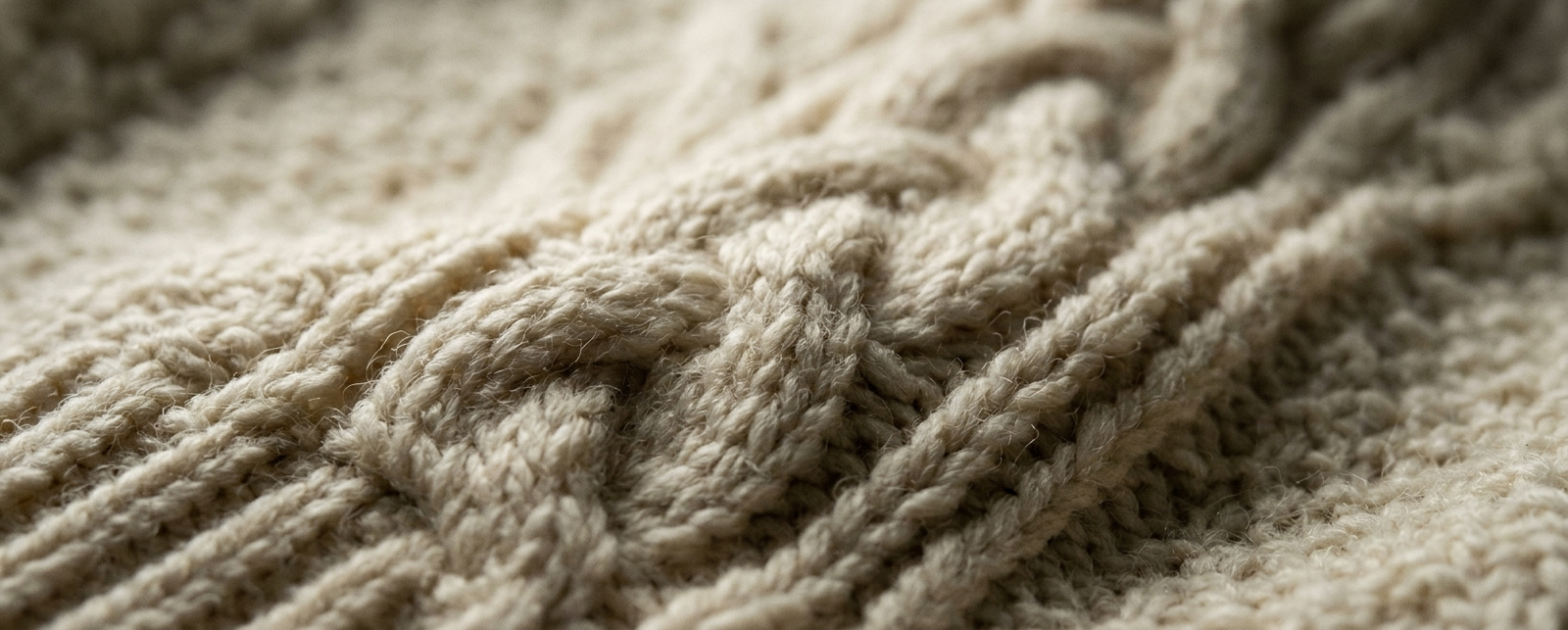
Most sweater trends are about color or silhouette. The cable is about structure. The twisted, raised pattern is visible from across a room and readable by touch. It’s a texture story that works in photos, in e-commerce zoom, and in hand.
That’s why it never dies. A cable knit doesn’t depend on a seasonal color story — it’s a permanent pattern language. Brands reorder cable knits year after year, changing only the colorway.
2. Why cable knits look expensive (and how to keep them that way)
A cable sweater lives or dies on three details:
- Pattern clarity. Every cable crossing has to be sharp and consistent. Blurry, sloppy cables happen when the pattern file is wrong or the machine tension is off.
- Yarn twist. Cables need a yarn with enough twist to hold the raised structure. Low-twist yarns go flat and mushy after a few washes.
- Stitch definition after wash. The wash sets the final look. A cable that’s over-washed loses its relief; under-washed and the garment feels boardy.
The pattern is a programming job, not an accident. Every cable crossing gets mapped on the machine before the first sample. That’s why the factory’s programming capability matters more than its knitting speed.
3. The production reality: cables are a programming game
Cables are built on the machine, crossing stitches according to a pattern file. A factory with old machines or a thin programming team will fumble this — the samples come back with uneven crossings and you burn weeks fixing them.
Lewen Garment runs 100 Cixing automatic knitting machines, which are built for pattern work, and the programming is done in-house. That means the pattern file, the sample and the production run all come from the same team — no translation loss between subcontractors.
One production note: a complex cable pattern takes programming time, and that time shows up on the quote. Start the pattern discussion before sampling, not after.
4. Which gauges carry cables best
Cables read best at mid-to-chunky gauges:
| Gauge | Cable effect | Best use |
|---|---|---|
| 3-5GG | Bold, deep relief | Statement fisherman styles |
| 7-9GG | Clear, classic | Everyday cable crewnecks |
| 12GG | Subtle, fine | Modern slim cables |
For a first cable program, 7-9GG is the safe bet: the pattern reads clearly, the garment stays wearable, and the yarn cost stays reasonable. When it is time to run the style, a custom knitwear manufacturer can review the cable spec and gauge before you commit to sampling.
5. Cable knit vs jacquard: what each one actually is
People mix these two up because they show up on the same sweater. They’re different things: one is texture, the other is image.
A cable is a stitch manipulation. The machine crosses stitches over each other in a set sequence, and those crossings build a raised rope that runs up the panel. The panel is usually one color, because the interest sits in the relief, not in the artwork.
Jacquard is a color-patterning method. The program tells the machine which yarn to knit at each needle, stitch by stitch, so different colors build a motif, a logo or a picture across the fabric. The surface stays relatively flat. The pattern carries the design.
So the short version: cable is texture, jacquard is image.
They aren’t mutually exclusive. A cable panel can also carry a jacquard motif — a factory can run the cable structure and a color pattern on the same garment, if the program and yarn counts support it. Plenty of winter styles do exactly that.
One thing to clear up for your product copy: “jacquard” says nothing about warmth. It’s a way of placing color. A fine 14GG jacquard and a chunky 3GG cable are different products — the difference comes from yarn weight, gauge and loft, not the word on the label. If those gauge numbers need unpacking, what GG means in knitwear covers the full scale.
6. Cable knit vs jacquard: how they compare on the factory floor
Both need pattern-capable machines and a programming team that knows the structure. After that, they pull in different directions. The third patterning route is intarsia, and it sits between them — intarsia vs jacquard explains when each one wins.
What drives cost isn’t the same thing. For cables, it’s programming time plus a slower carriage — every cross-over makes the carriage work harder, so a panel packed with crossings runs slower than a plain knit. For jacquard, it’s program complexity, more yarn ends and more color changes per row. Each extra color adds a yarn supply — more carriers, more stops, a slower run.
Yarn consumption follows the same split. Cables eat more yarn than a plain knit at the same gauge, because crossings pull yarn into the structure and the panel knits denser. Jacquard eats more yarn as color count rises — every color needs its own supply, and the floats on the back use yarn that never shows on the face.
| Cable knit | Jacquard | |
|---|---|---|
| What it is | A stitch manipulation — crossed stitches | A color-patterning method — yarn chosen per stitch |
| Main cost driver | Programming time, slower carriage from cross-overs | Program complexity, yarn ends, color changes per row |
| Yarn consumption | Higher than a plain knit at the same gauge | Rises with color count and float length |
| Weight and warmth | Follows yarn weight, gauge and loft | Follows yarn weight, gauge and loft |
| Artwork limits | Bold, structural, reads from a distance | Motifs, logos and fine pattern |
| Color range | Usually one, sometimes a contrast yarn | As many as the machine and program support |
| Machine capability | Pattern-capable machine plus cable programming | Pattern-capable machine plus enough yarn carriers |
| Gauges that suit it | 3-12GG, best at mid-to-chunky | Mid to fine, 12GG and up for detail |
| Sampling risk | Uneven crossings and tension | Float tension and joins where colors meet |
| Typical garments | Fisherman crewnecks, textured cardigans | Logo knits, motif sweaters, color-block styles |
Weight and warmth deserve their own line, because this is where most comparisons go wrong. Warmth follows yarn weight, gauge and loft — not the technique. A chunky cable and a fine jacquard aren’t the same product, and a jacquard can be knitted thick or thin.
Cables fail on uneven crossings and drifting tension. Jacquard fails on float tension, color joins and edges where two colors meet. Neither is solved on a drawing — both need a test panel before bulk.
7. Which one to spec (and how to brief it)
Choose cable when the design is texture-led, single-color and heavy winter knitwear. The customer is buying the handfeel and the structure, and a second color would only muddy it.
Choose jacquard when the design is the pattern — logos, motifs, color blocking. If the artwork is the product, it’s a jacquard job.
Choose both when the style needs texture and artwork. A cabled body with a jacquard logo or cuff is doable. Just expect longer programming and sampling, because you’re asking the machine to do two jobs at once.
Either way, the factory needs the same three things from you: the gauge, the yarn, and a spec the technician can work from. For jacquard, that’s a clean chart or graphic with the color count locked. For cable, it’s a cable spec — a reference garment, a photo or a chart showing the crossing pattern and the repeat. Vague references cost you weeks, because the technician has to guess and you fix it in sampling.
8. What this means for brands and designers
- Treat the pattern as a spec. Ask for the pattern file, not just a sample photo. The file determines the production consistency.
- Budget programming time. Complex cables add pattern cost and sampling time. Plan it into the calendar.
- Pick 7-9GG to start. Classic cable clarity at a wearable weight — the safest entry point.
- Check the after-wash hand. Ask for a washed sample. The wash sets the cable relief and the hand feel.
The cable knit is the most reliable sweater a brand can program — it sells every year, in every market, without a trend cycle. The only variable is execution: pattern programming, yarn twist and wash control. That’s what Lewen Garment delivers out of Dalang, Dongguan — men’s and women’s knitwear, 3GG to 18GG, in-house pattern programming, with a 100-piece MOQ and samples in 7-10 days.
FAQ
Why are cable knit sweaters always in style?
Cables are a texture story, not a color story. The raised pattern works in any season and any market, so brands reorder them year after year with only colorway changes.
What makes a cable knit look high quality?
Sharp, consistent pattern crossings, yarn with enough twist to hold the relief, and a wash that sets the stitch definition without flattening it.
Why do some cable sweaters have blurry patterns?
The pattern file or machine tension is wrong. Cables are programmed stitch-by-stitch, so a factory’s programming capability determines the pattern clarity.
What gauge is best for a cable knit sweater?
7-9GG is the classic carrier — clear pattern, wearable weight, reasonable yarn cost. Chunky 3-5GG gives deeper relief; 12GG gives a subtle modern cable.
Can Lewen Garment program custom cable patterns?
Yes. Lewen Garment programs cable patterns in-house on Cixing automatic knitting machines, so the pattern file, sample and production run come from the same team.
Is jacquard knit warmer than cable knit?
No — warmth isn’t the technique. It follows yarn weight, gauge and loft. A chunky cable and a fine jacquard are different products, and a jacquard can be knitted thick or thin. If you want warmth, spec a heavier yarn and a coarser gauge, then pick whichever technique fits the design.
Is jacquard knit or woven?
It can be either. Jacquard is a patterning method used on both knitting machines and weaving looms — the loom or the machine selects which yarn shows at each point to build the pattern. In knitwear, it means a knitted jacquard, built stitch by stitch on a flat knitting machine.